Research/Fūdo Is Not Landscape/Argument III/Chapter 6
Academic edition · Fūdo Is Not Landscape · Chapter 6 · 10 / 34
Repetition and Difference
Argument III · Representation Passes Through Repetition and Subtraction to Become Expression
The Ieodo Series and the Form of Memory
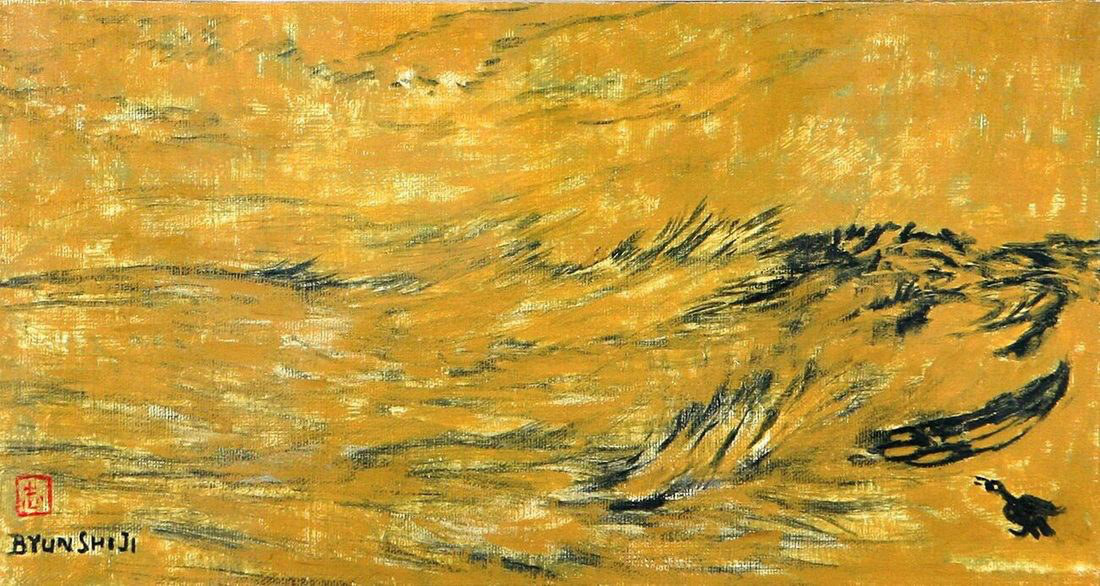
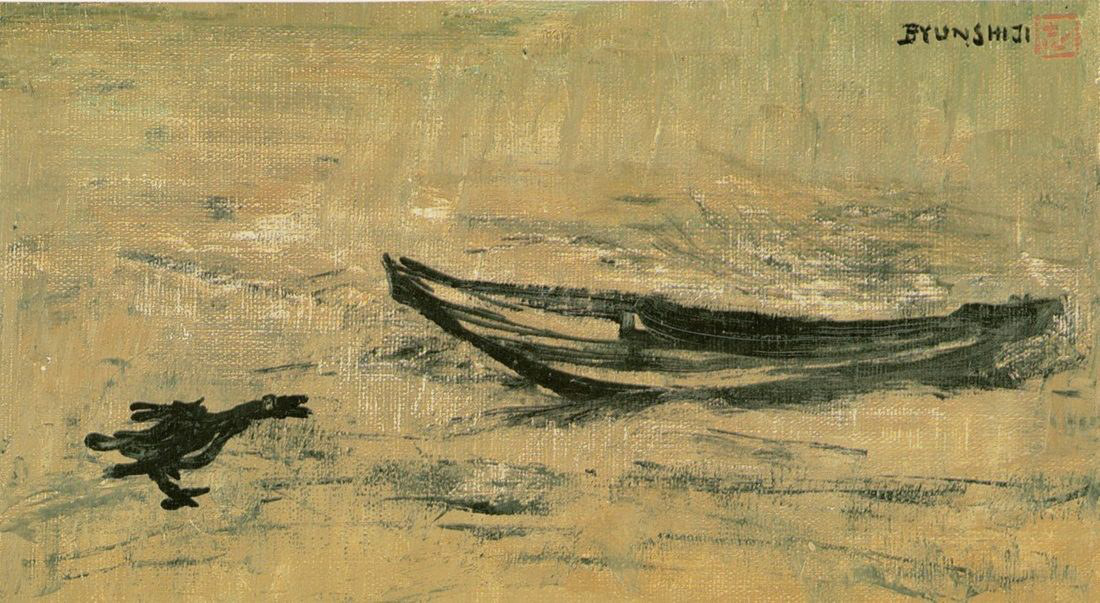
1The Crow That Came Again
In Ieodo (1987) an empty boat has reached the shore, and a crow has alighted beside it.1 The boat is drawn small and black at the lower right of the picture, and the crow stands right beside it. Ieodo (1980), seven years earlier, also had an empty boat with a single crow beside it.
The same title, the same pair. But not the same picture. Under the title Ieodo alone there are several works from 1977 to 2005.2
Why did he paint the same thing again and again? While painting it again and again, what stayed the same, and what changed?
2Reverence and Form: Repetition Is Not the Reproduction of Sameness
Byun Shi-Ji said he thought deeply every time he painted the sea. His reverence for the sea does not change, but the pictures differ with the season, the time of day and changes in the air.3 In these words repetition can be read not as copying the same image but as work that sustains the tension between an unchanging attitude and a changing form.
Boat, crow, horse and house reappear, changing size and position, distance and colour from year to year and work to work. This repetition can be seen less as making Jeju into a fixed symbol than as reconstructing the relation between memory and work each time.
3The Same Motif, a Changing Form
Placed side by side, the two Ieodo paintings of 1980 and 1987 show that repetition produces difference. The relation of empty boat and crow is kept, but the size and position of the boat, its distance from the crow, the ground colour, the density of brushwork and the proportion of empty space change.
The unit for reading the series is therefore the change of relations more than individual things. One must trace at what distance the same motif is placed, how small it becomes, and in what colour field it is isolated or joined.
This difference also has to do with how memory works. He did not paint from photographs. He said that painting only from photographs kills the imagination, and that what is seen with the eyes and “learned in the head” is “more accurate even than a photograph.”4 A motif that has passed through memory becomes not a representation of the same object but a relation reconstructed each time. So his sea is always the same and a little different each time he paints it.
Seen this way, repetition can be read not as a way of possessing a place but as a way of renewing his relation with it.
4The Mountain of Home, the Sea of Home
The French painter Cézanne (1839–1906) painted again and again Mont Sainte-Victoire, which overlooks his home town of Aix-en-Provence in the south. In a letter of 1878 he called the mountain “a beautiful motif.” From about then until his death in 1906 there are some eighty oils and watercolours. In his last years he painted looking at the mountain from around his studio at Les Lauves, north of Aix.5 Byun Shi-Ji too wrote of Cézanne in Art and Fūdo: that Cézanne found a principle through “ceaseless observation of nature.”6
Both men painted the landscape of home repeatedly into old age. There are differences too. Cézanne painted facing the mountain. Byun Shi-Ji looked at the sea, came home and painted in the house.
A few weeks before he died, Cézanne wrote to his son that as a painter he was coming to see more clearly before nature, but that realizing what he felt was always very difficult.7 Byun Shi-Ji too said he was about seventy or eighty percent satisfied with his work, adding that complete satisfaction cannot be achieved.8
5The Brush That Has Already Passed
Painting again is not copying. In his book he wrote that imitation is “not copying but the spirit of creation.”9 According to Neves, he believed that imprinting the relation of people and nature again and again could give rise to a new consciousness, beyond a memorable picture.10
In his last years, he said, he sometimes began two pictures together, and took up the brush only after long thought. If something good came by chance and he touched it to make it better, it vanished, and he “can’t put it back. It’s already passed.” So he tried, carefully, for “one completion.”11
A brush that has passed cannot be taken back. Instead of taking it back, he painted again.
Between the two Ieodo paintings, the size of the boat and the distance between crow and boat changed. This chapter has confirmed that his repetition was a matter of correcting form again and again on the basis of an unchanging attitude. Then what did he try to grasp by painting again: the outward look of the sea, or the meaning within it? The next chapter takes up this question with the word xieyi (寫意), and looks also, in A Single Dot (2006), at what he subtracted from the canvas for the sake of that meaning.
His posture before the sea was the same. The pictures were never the same.
Notes and sources
- ↑ The empty boat and single crow beside it in Ieodo (1980) confirmed by the author. Ieodo (1987) follows the description in “The Language of Painting” (p. 347). Both canvases are checked against the plates in the byunshiji.org 100 Works (FŪDO 063, 064).
- ↑ Based on the list in “The Language of Painting”: 1977, 1978, 1980, 1987, 1991 (two works), 2005.
- ↑ Carole Neves (director of policy analysis, Smithsonian Institution), “The Painter and the Sea: Byun Shi-Ji.” Original English: “Whenever I paint the sea, I think deeply about it. Thinking deeply about the sea allows me to paint it again and again. My reverence for the sea remains constant, but my images vary based on differences in seasons, times of day” — the quotation marks of the original close here, followed by “and atmospheric variations.”
- ↑ Byun Shi-Ji Oral History Transcript (Korean Modern and Contemporary Art History Oral History Project; interviewer and researcher Lee In-bum), seventh session (1 April 2005), pp. 297–299.
- ↑ Paul Cézanne (1839–1906) was born and died in Aix-en-Provence. The “beau motif” of the April 1878 letter, the number and dates of the Mont Sainte-Victoire series, and the Les Lauves studio (from 1902) follow the summary in the Wikipedia article “Mont Sainte-Victoire (Cézanne).”
- ↑ Art and Fūdo, “Cézanne and the Simplification of Form.”
- ↑ Cézanne’s letter to his son Paul, September 1906. English translation: “as a painter I am becoming more clairvoyant to nature, but that it is always very difficult for me to realize my feelings.”
- ↑ Neves, same essay. Original English: “he is 70%-80% pleased... the achievement of total satisfaction is impossible.”
- ↑ Art and Fūdo, “The Essence of Imitation.”
- ↑ Neves, same essay. Original English: “Imprinting the relationships between humans and nature, he believes, can result in a new consciousness, not merely a memorable image.”
- ↑ Byun Shi-Ji Oral History Transcript, seventh session, pp. 301–302.
Contents · Fūdo Is Not Landscape Key Terms and Analytical Categories → Bibliography →