Research/Fūdo Is Not Landscape/Argument II/Chapter 4
Academic edition · Fūdo Is Not Landscape · Chapter 4 · 7 / 34
Homecoming and Relearning
Staying and Looking Again
Argument II · Homecoming Is Not a Return to Origin but Relearning
In 1975 he came down to Jeju, the island where he was born, and lived there for the next thirty-eight years. This chapter sees that homecoming through two pictures. Case A asks, through The Empty House (1987), painted many years after he settled in Jeju, what the days of deciding not to leave left in the painting. Case B goes back to Jeju (1976), painted just after his return, and asks how the eyes of a returning person came to see the same island again. Together the two cases ask whether homecoming was a return to origins or a relearning.
Case AWhen Jeju Becomes a Method — Staying, Dwelling, The Empty House
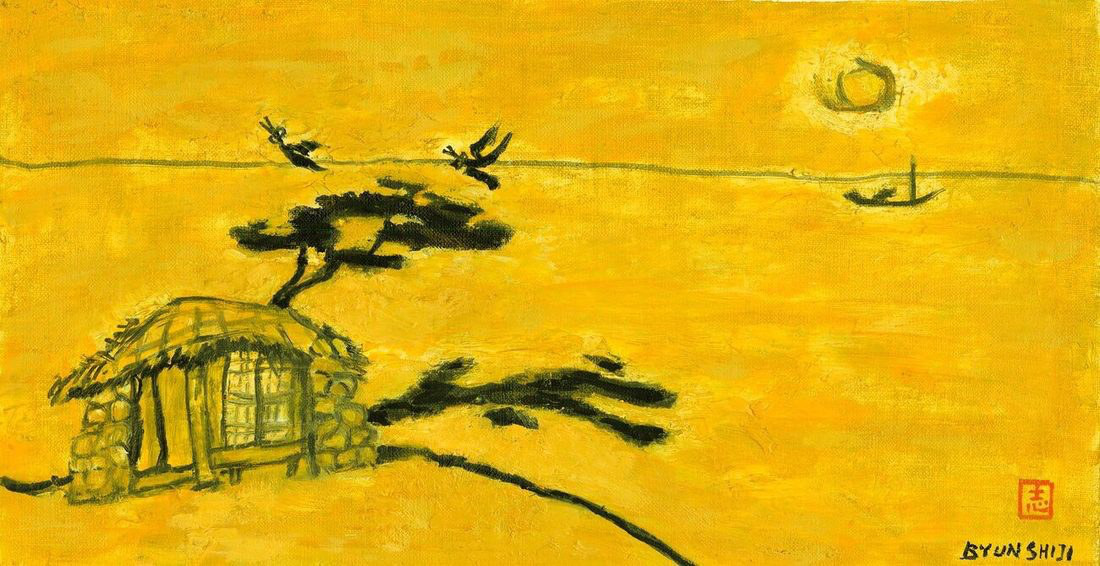
1The House on the Hill
In The Empty House (1987) there is one house, on a hill at the left of the picture. It is a thatched house. A roof sits on walls of piled stone, and the door has lattice bars. The door is closed. On the slope below and to the right of the house lies a black rock. It is shaped like a hand, with five fingers.1 A pine stands beside the house, and above it two crows fly. Over the horizon are the sun and one boat. The whole surface is a bright color of dried grass.
The title says the house is empty. Yet the door is closed. Who closed the door of the empty house?
2From Eleven Days to a Year
In 1975 the art education department of Jeju National University had no one to teach aesthetics and art theory. At first he declined the invitation, because of his children’s schooling. Then came a request to come and teach only twice a year, in spring and autumn.2
He came down meaning to stay only eleven days. But he grew attached. People around him urged him to stay. He said he would stay one semester; when the semester had passed, he spoke of a year.2 That one year became thirty-eight.
His family was in Seoul. The family came to Jeju and he went to Seoul, but the days they spent together were mostly special occasions and anniversaries.3 He named as the greatest sources of peace of mind the stability of society and his wife, children and grandchildren. And yet he said he could not imagine living anywhere but Jeju.4
This chapter calls this “staying.” Days of deciding not to leave pile up and become staying.
3The Closed Door
Back to the picture. In this canvas the eye stops at two places: the hand-shaped rock and the closed door.
The hand is on the slope below the house. The black rock lies stretched out to the right from below the house’s right side. Its end splits into several branches, like a hand with fingers spread. He once wrote that the “abstract reefs” of the shore, looked at from many directions, become “an illusion” and “a symbol.” Their curves, he said, let one taste “a true, wordless dialogue.”5 Neves wrote that he painted the same subjects again and again, and often painted his own hands.6 This rock cannot be declared to be the painter’s hand. But in this picture the hand lies just below the house, lower than the house.
The door does not show the inside. Had the door been open, it would be read as a house the people had left, with only the wind going in and out. A closed door reads differently. Someone closed the door and left, or someone still looks after this house. The picture does not say which.
4Staying, Caring
Philosophical discussions that understand dwelling not as mere occupation but as staying and sparing stress that a house is a form that endures by taking account of climate and the conditions of life.7 The Black Forest farmhouse that Heidegger cites is likewise presented not as a device for conquering nature but as a form of dwelling that takes account of storms and the cycle of life.
Byun Shi-Ji’s writing has passages that can be read alongside this. He wrote that he sometimes asked himself, “What is home?” Comparing Jeju past and present, he said, he often thought that “Jeju belongs to Jeju.” Jeju’s beauty, he wrote, “lies solely in its being Jeju.”8 It is a wish to let Jeju be as it is, and look.
There are differences too. His staying was a staying apart from his family. He later said that had he lived comfortably with his family in Jeju as well, he “could not have given up that kind of painting”—meaning the Biwon manner that had become second nature. He remembered the time when he put that manner down and first began Jeju painting as a time when he had nothing to lean on.9
5The Island That Became a Method
After giving up the Biwon colours, he said, he sank into worry day and night, even sitting by the sea.10 Staying was not keeping still. It was painting.
In the spring of 1988, thirteen years after coming to Jeju, he wrote the preface to Art and Fūdo in his Jeju studio: “Jeju has now become for me less an artistic space than an aesthetic ground and a method.”11 We may call it what staying did.
The closed door can be read this way too. It need not be only the door of an abandoned house. It may be the door of a house someone cares for. It may also be the door of a house that has become out of reach. The picture does not separate the two.
In this case, staying appeared not as keeping still but as the condition for painting with Jeju as a method.
He wrote that Jeju had become a “method” thirteen years after he came. At the start of that time, how did the returning man’s eye see the island? Case B goes back to Jeju (1976), eleven years before The Empty House, to ask this question.
Case BThe Visuality of Homecoming — The Time in Which Landscape Becomes Fūdo
1The Same Island, Different Colours
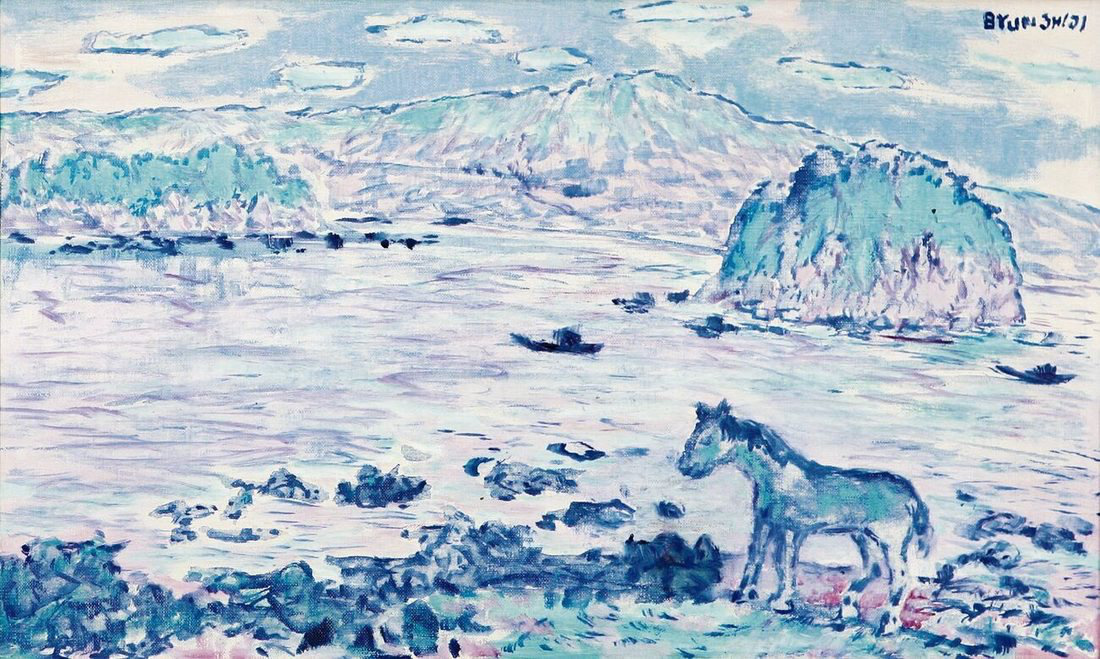
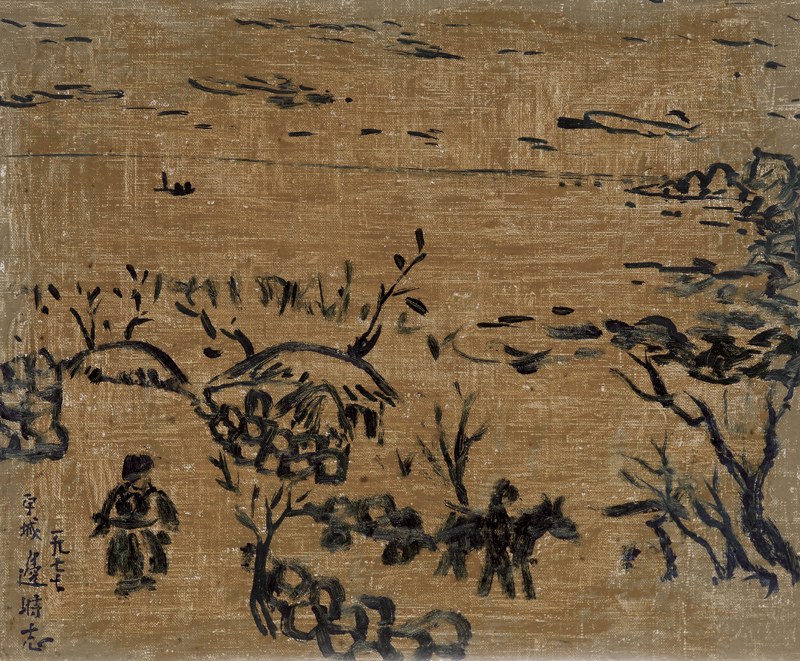
In Jeju (1976), painted the year after his return, the mountain is violet, the sky has a pink tinge, and the sea is blue. The horse is blue too.12 In Seogwipo (1977), a year later, the bright and varied colours he had used until then still remain. They differ greatly from the restrained tones of the pictures he later painted in Jeju.
Over time the pictures painted in Jeju change. The number of colours shrinks, and the surface gathers toward the color of dried grass.
The same painter painted the same island. The island did not change. Then what changed?
2The Eyes of the One Who Returned
In 1975 Byun Shi-Ji moved from Seoul to Jeju. Jeju is the island where he was born. But it was also a place he had long been away from, after crossing to Osaka as a child.
To someone who returns after long absence, a once-familiar place can look strange.
The eyes of the one who returned can be seen in two kinds.
3Seeing Twice
The first eye sees as if for the first time. To the returning person the island is welcome and new. Sea, sunlight and fields enter the eye all at once. In the terms of the introduction, Jeju at this point is still close to a “landscape” spread before the eyes. The bright colours of Jeju and Seogwipo suit this first eye well.
The second eye is the eye that lives within. As years pass, the island is no longer only new. Instead, wind and sunlight accumulate in the body. The many colours in the pictures gradually gather into one tonality, lines bend, people grow low. The landscape once looked at can be read as having become fūdo that has entered the body.
What changed is the place of seeing. The two eyes follow one upon the other.
4Defamiliarization, and After
Shklovsky’s “defamiliarization,” in making the familiar seen anew, can be compared structurally with the strangeness of homecoming.13 But the one is an artistic technique and the other an event of life, so the two are not equated.
What matters here is that Jeju, returned to after long absence, was both a home already known and a place that had to be seen again.
For him, seeing things as strange was not an end but a beginning. Over time the sense of newness turned into the experience of living within a fūdo.
5Until Fūdo Became Form
Byun Shi-Ji learned the forms and techniques of modern painting in Japan. Through the Seoul years he carried his painting on. And he lived and painted in Jeju for thirty-eight years.
Methods of painting learned outside and time lived inside met on one canvas. In that meeting Jeju went beyond subject matter to become a condition that changed the form of painting. What he had learned was not erased. The way of drawing the human body and the idea of simplifying painting came from Tokyo, where he studied, and he rewove them in Jeju. That lineage was confirmed in chapters 1 and 2.
Fūdo did not become the form of his painting from the day he arrived in Jeju. It took time: to see the strange home again, to live there long, for wind and sunlight to accumulate in the body. The painter himself later said in his oral history that only after living in Jeju for some years did he come to know its fūdo, its history and the will of its people.14
Even with dates hidden, comparing colour alone separates the many-coloured pictures from those gathered into one colour. This case shows that the time in between turned “the eye that sees as if for the first time” into “the eye that lives within.”
The two cases are two sides of the same homecoming. The returning man’s eye first saw the island as if for the first time and then became an eye that lives within it, and the days of deciding not to leave turned Jeju into a “method” of painting. In this sense his homecoming can be read less as a return to origins than as a relearning. Yet in the pictures of the man who stayed, an old man walking with a cane appears often.15 The next chapter follows The Path Rejoined (1998) to ask why a man who stayed in one place painted people on the road.
The one who returns sees twice: once as if for the first time, once while living within.
Notes and sources
- ↑ The Empty House (1987). Facts of the canvas (the house on the hill, the hand-shaped rock on the slope below it, five fingers, the closed door) confirmed by the author (30 September 2026: “As in the painting. The house is on the hill”). “The Language of Painting” gives the title as Binjip, speaks of a house facing the sea, pine branches swaying in the wind and a departing boat, and states that the door “is open.” This book follows the author’s confirmation. The canvas is checked against the plate in the byunshiji.org 100 Works (FŪDO 062).
- ↑ Byun Shi-Ji Oral History Transcript (Korean Modern and Contemporary Art History Oral History Project; interviewer and researcher Lee In-bum), sixth session (19 January 2005), pp. 257–258. The fifth session (18 January 2005), p. 200, also records that he declined a full-time post because his whole family was in Seoul.
- ↑ Hong Seong-hu (researcher, Institute of Korean Art History, Myongji University), “Beyond Boundaries: The Life and Art of Byun Shi-Ji,” in the “Art and Fūdo” file.
- ↑ Carole Neves (director of policy analysis, Smithsonian Institution), “The Painter and the Sea: Byun Shi-Ji.” Original English: “His greatest sources of tranquility are social stability and his wife, children and grandchildren. Periodically, they travel to Jeju and he visits Seoul, but he cannot imagine living anywhere but Jeju.”
- ↑ Byun Shi-Ji, Art and Fūdo (Youlhwadang, 1988), “Island of Illusion, Rock of Symbol,” in the section “Living in Jeju.” The book writes “wordless” as 무언(無言).
- ↑ Neves, same essay. Original English: “Byun repeatedly paints the same subjects. Often he paints his own hands.”
- ↑ Martin Heidegger, “Bauen Wohnen Denken” (Building Dwelling Thinking), Darmstadt lecture, 1951, in Vorträge und Aufsätze (1954). The text paraphrases these passages: “das Bleiben, das Sich-Aufhalten”; “Wunian heißt: zufrieden sein, zum Frieden gebracht, in ihm bleiben”; “Der Grundzug des Wohnens ist dieses Schonen”; “wenn wir etwas zum voraus in seinem Wesen belassen”; the Black Forest farmhouse (“gegen die Stürme der langen Winternächte,” “Kindbett und Totenbaum”).
- ↑ Byun Shi-Ji, Art and Fūdo, “Living in Jeju,” in the section “Living in Jeju.”
- ↑ Byun Shi-Ji Oral History Transcript, seventh session (1 April 2005), p. 302 (“because there was nothing to lean on”), p. 303.
- ↑ Same transcript, seventh session, p. 304.
- ↑ Byun Shi-Ji, Art and Fūdo, “Preface” (spring 1988, in the Jeju studio).
- ↑ Jeju (1976). The canvas is checked against the plate in the byunshiji.org 100 Works (FŪDO 096).
- ↑ Viktor Shklovsky, “Art as Technique” (Искусство как приём, 1917).
- ↑ Byun Shi-Ji Oral History Transcript (Korean Modern and Contemporary Art History Oral History Project; interviewer and researcher Lee In-bum), fifth session (18 January 2005, Gidang Art Museum), p. 221: “You come to know a certain fūdo called Jeju, or the historical things, or a certain will of the Jeju people in their lives, these things, because you live there for some years.”
- ↑ Neves, same essay. She wrote that “an old man walking with a cane” appears in many paintings, including pictures of European monuments.
Contents · Fūdo Is Not Landscape Key Terms and Analytical Categories → Bibliography →