Research/Fūdo Is Not Landscape/Argument II/Chapter 5
Academic edition · Fūdo Is Not Landscape · Chapter 5 · 8 / 34
The Path Rejoined
Argument II · Homecoming Is Not a Return to Origin but Relearning
The Path Rejoined and a Pictorial Study of Movement
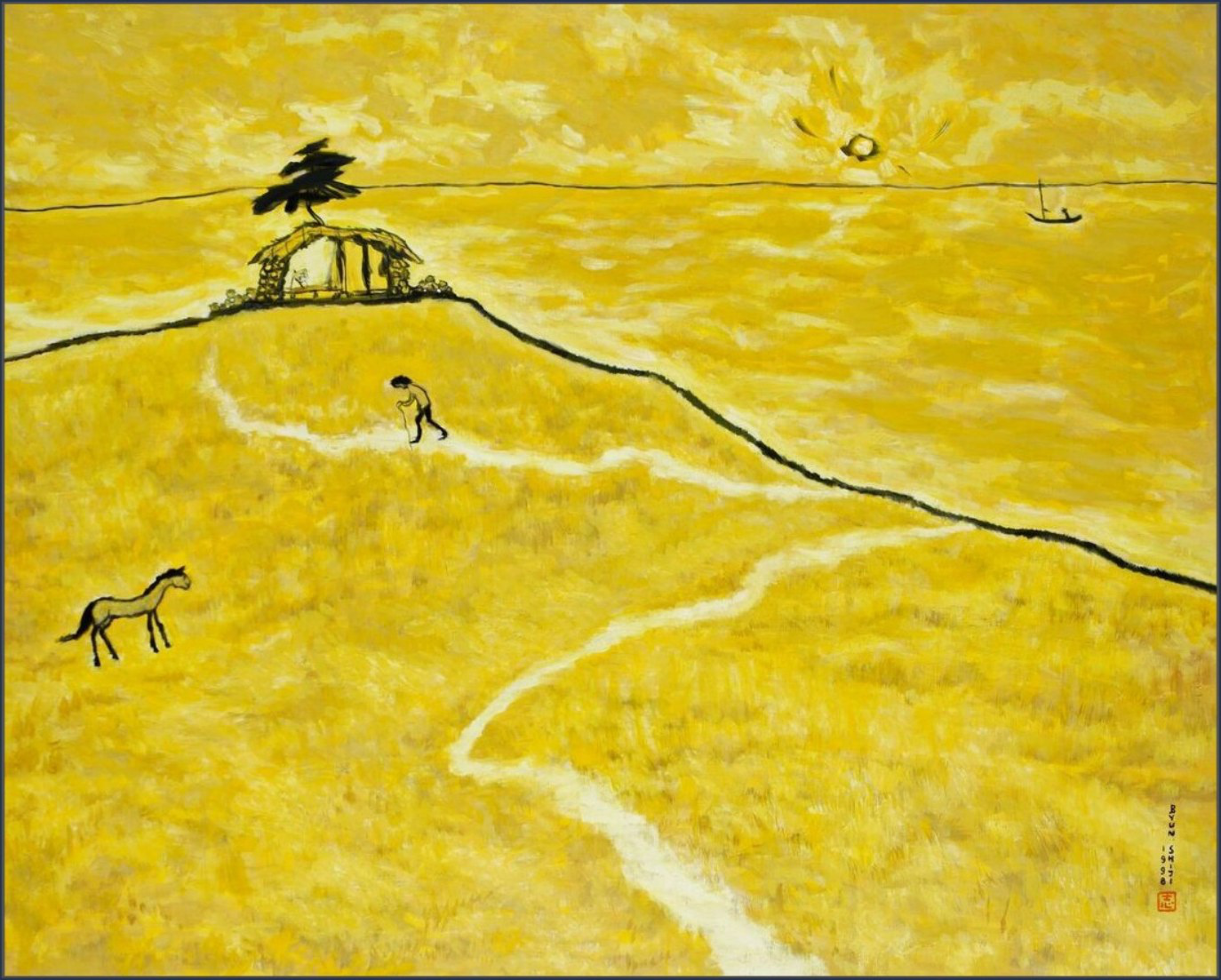
1From the Cliff to the House
A path runs up the hill in The Path Rejoined (1998). According to the description in “The Language of Painting,” the path first heads toward the cliff and later turns toward the house.1 The white path rises from the bottom of the picture, bends right toward the cliff, then turns left again and goes to the house on the hill. The edge of the cliff is divided from the sea by a single black line. On the path is a person walking with a cane, and at the lower left of the picture stands a horse.
The title holds the word “again.” It says that what was broken was joined. What was broken, and what was joined?
It is a path painted by a man who stayed. Before reading that path, we follow the paths in his life.
2The Sea on the Day of Leaving
Leaving came early. Standing on the wooden floor of the family house in Seohong-dong, Seogwipo, one could see the sea in front. At that time, it is said, there were no orchards and no windbreak trees. One day a large ship bound for Japan came and stood in that sea. The water was shallow and the ship could not come close. People crossed in small boats and were pulled up by hands reaching down from above. Someone’s white rubber shoe fell into the sea. It was the journey on which his father took him, his younger brother and his elder sister. When they reached Busan the smell was different. He remembered it as “the smell of civilization.”2
After that, by way of Osaka, Tokyo and Seoul, he came back to Jeju. In the preface to Art and Fūdo he wrote of this path. He “crossed to Japan at the age of six” and began to paint. The days of his youth there, and of his later years in Seoul and Jeju, he called “a long period of searching and departure.”3
The word to note is “departure.” He called even the time after returning to Jeju a departure. For him leaving and returning were not two separate, broken-off things. They were on one path.
3On Foot, Alone
On the paths in his pictures there is often a person: an old man walking with a cane. He does not hurry. He steps on the ground one pace at a time, walking with a slight lean. So does the person in The Path Rejoined, climbing toward the house, leaning on his cane with his body bent forward. Neves wrote that the old man appears even in paintings of European monuments.4
He himself was a walker. In 1981 he went to Europe for the first time.5 He was with a group, but after breakfast he set out around nine and walked all day. Where there was something to paint, he painted there. Because he knew French he could find his way “on foot, alone.” With his bad leg, he remembered, he asked the way as he went and “did not take a single wasted step.”6
In Jeju, too, he walked. Whenever his surroundings changed, he wrote, he would “go alone to find” the home of his remembered childhood. Seeking out and painting the places that had not vanished, then or now, those places became his favourite subjects.7
Here is one reason why there are so many people on the road in the pictures of a man who stayed. For him, staying was also walking long in one place.
4A Picture of Searching for the Ox
A year before this picture he painted Simudo (1997).8 Simudo means “pictures of searching for the ox.” In Seon (Zen) Buddhism, they show in ten scenes the process of finding, taming and returning with the ox, a figure for human nature. In the sixth scene the person rides the ox home. In the tenth and last, the person comes out again among people, carrying a bag and a staff.9
I have found no words telling what meaning he gave this title. But in this old picture too, returning is not the end. So was Byun Shi-Ji’s path. On the island he returned to, he walked again, and painted as he walked.
5The Path Rejoined
Back to the title The Path Rejoined. What was broken may have been the long time between the island he left as a child and the island he returned to before turning fifty. That time was joined within the picture. He wrote of facing the canvas that it was “perhaps one of the processes of reconfirming my existence.”10 Confirming again is also joining again.
The path is a line that bends but does not break. Even when it seems cut, it joins again. It is this line, too, that joins leaving and returning into one.
The white path of The Path Rejoined heads toward the cliff and then turns toward the house. This chapter has confirmed that for him leaving and returning, staying and walking, were on one path. Read with chapter 4, his homecoming can be summed up not as going back to the place he left but as relearning home by staying and walking. This is the provisional conclusion of Argument II. The path was not painted only once. There is a picture called The Road from the Seoul years,11 and in Jeju an old man with a cane stood on the road over many years. The next chapter, opening Argument III, asks through the Ieodo series what stayed the same and what changed while the same thing was painted again and again.
Returning, too, was a path.
Notes and sources
- ↑ The Path Rejoined (1998). Description of the canvas follows “The Language of Painting” (p. 535). The canvas is checked against the plate in the byunshiji.org 100 Works (FŪDO 034).
- ↑ Byun Shi-Ji Oral History Transcript (Korean Modern and Contemporary Art History Oral History Project; interviewer and researcher Lee In-bum), first session (3 December 2004, Gidang Art Museum), pp. 25–26.
- ↑ Byun Shi-Ji, Art and Fūdo (Youlhwadang, 1988), “Preface.”
- ↑ Carole Neves (director of policy analysis, Smithsonian Institution), “The Painter and the Sea: Byun Shi-Ji.” Original English: “the old man who walks with a cane in many of his paintings, including his paintings of European monuments.”
- ↑ Byun Shi-Ji Oral History Transcript, second session (4 December 2004), p. 105. In October of the same year he held an invitational exhibition at the Galleria Astrolabio, Rome (biography in the transcript). There is also Useong Byun Shi-Ji: European Travel Paintings (Samhwa Publishing, 1982).
- ↑ Same transcript, sixth session (19 January 2005), pp. 272–273.
- ↑ Art and Fūdo, “The Folk Art of Jeju,” in the section “Living in Jeju.”
- ↑ Simudo (1997). Title and date follow “The Language of Painting” (p. 533).
- ↑ The ten scenes are: searching for the ox (尋牛), seeing the traces (見跡), seeing the ox (見牛), catching the ox (得牛), herding the ox (牧牛), riding the ox home (騎牛歸家), the ox forgotten, the self remains (忘牛存人), both ox and self forgotten (人牛俱忘), returning to the source (返本還源), entering the marketplace with open hands (入廛垂手). They derive from Puming’s Ox-Herding Pictures and Kuoan’s Ten Ox-Herding Pictures of the Song dynasty; Korea mainly follows Kuoan. See “[Temple Murals 6] The ‘Ten Ox-Herding Pictures’ of Baengnyeonsa, Gangjin, Setting Out to Find the Way” (Uri Munhwa Sinmun) and “Temples Under a Magnifying Glass ⑬: Simudo” (Geumgang Sinmun).
- ↑ Art and Fūdo, “Living in Jeju,” in the section “Living in Jeju.”
- ↑ “The Language of Painting” includes two pictures titled The Road from the Seoul years (1960, 1961). Hong Seong-hu’s essay cites The Road, drawing on a review by the critic Lee Gu-yeol.
Contents · Fūdo Is Not Landscape Key Terms and Analytical Categories → Bibliography →