Research/Fūdo Is Not Landscape/Argument I/Chapter 2
Academic edition · Fūdo Is Not Landscape · Chapter 2 · 4 / 34
Imperial Art Education and Western-Style Painting in Motion
Training in Osaka and Tokyo and the Movement of Form
Argument I · Modernity Is Reconstructed in Motion
1Two Hands
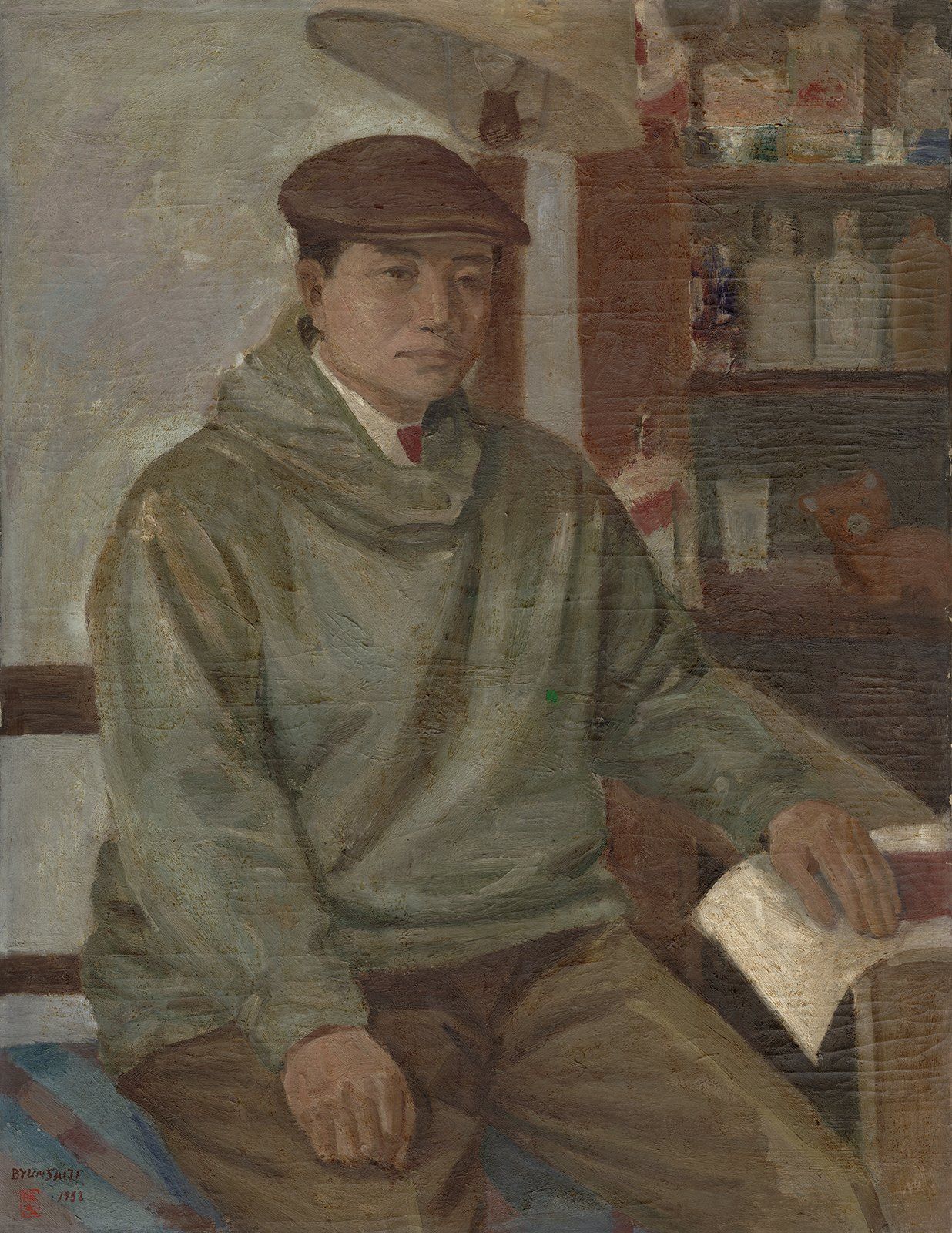
In Portrait of Mr. K (1952) there is one man. He wears a field jacket. His left hand rests on a red circle, his right hand on his right foot.1
It was painted in Tokyo. In his mid-twenties he had already won the top prize at the exhibition of the Japanese art society Kōfūkai, and was a member of the society.2
The person in this picture differs from the people of the Jeju years. You can see even where the two hands are placed. This chapter asks whether the drawing learned in Tokyo was discarded in Jeju, or remained in another form.
2The Osaka Art School and Imperial Movement
Calling Byun Shi-Ji’s training at the Osaka Art School simply “study in Japan” erases the colonial conditions of his movement. Kim Ji-young’s 2016 study points out that the Korean students of the Osaka Art School had different social backgrounds from those studying at the Tokyo School of Fine Arts, and that many received art education after settling in Osaka with their families’ economic migration.3
The study also stresses that after Liberation the Korean students of Osaka did not necessarily head for the Seoul art world, but returned to Jeju and the south and took part in art education and the formation of regional art. Byun Shi-Ji is included in the study as one case of this group. This makes it hard to explain his Japanese experience only as “acquiring advanced culture at the centre and bringing it home.”
What matters is that movement within the empire produced at once the acquisition of skill, insecurity of identity, and problems of language and name. The Self-Portrait and the change of name seen in chapter 1, the Tokyo training and the return to Korea in 1957 must be read on this continuous line. The form of Western painting was already within a history of movement.
For the year of entry, current sources give both 1941 and 1942. This book does not assert either; it will settle the date before publication from primary sources such as the school register and graduation records.
3Correcting and Bringing It Back
Before the end of 1945 he finished the Osaka Art School and went to Tokyo. The next spring, on a bus, he recognized a painter he had seen only in photographs: Terauchi Manjirō (1890–1964), a Japanese Western-style painter known for female nudes. When he asked if he might visit, the answer was yes.4
The teacher did not teach in the studio. When the pupil brought a picture, he only said what was wrong where. The pupil went back and corrected it, and about a week later brought it again—until the word “good” came. He gave up that spring’s exhibition.4
When senior pupils tried to add their own words about his pictures, Terauchi stopped them from saying needless things. That, he said, was exactly this pupil’s good point.4 At his first solo exhibition in 1949, Terauchi wrote a recommendation asking support for a pupil who pressed on, enduring “the wind and snow of the way of painting”—the wind and snow one meets on the path of painting.5
What he learned was not to come to resemble his teacher’s paintings. It was to keep correcting his own pictures before his teacher’s eyes.
4Line and Pose
He said that the beauty of a figure lies “in the line, or in the pose.” And he also said: “A figure has no tricks. You can’t deceive with it.”6 A landscape painted a little larger or smaller could still exist as such a landscape, but a human body shows the slightest error.
At that time the largest picture submitted to an exhibition was size 50. A size-50 figure (F) canvas is more than a metre on its long side.6 Painting a single figure left empty space on both sides, which was usually filled with a table or a vase. He felt there was no reason to place other things just to fill the gaps when he was painting the figure because it was beautiful. He cut the canvas so that one figure just fitted, and had the stretcher and frame made to match.6
In Portrait of Mr. K, too, the eye goes to the posture of the body. Where the two hands are placed decides how this person sits.
5Following the Old, Knowing How to Change
The teaching of his teacher that he remembered longest was about light. Under light the colours of things reflect into one another. A white cup beside something yellow is tinged yellow. In the paintings of the Impressionists—French painters of the late nineteenth century who tried to capture outdoor light and changes of colour in the atmosphere—shadows are not black but blue.7 He said he painted the dark parts of figures blue and removed black from his palette.8
He also knew the weight of what he had learned. He said that strength in drawing was not always good. When forms had to be reduced and changed, one could not break free of it.7
How to master tradition without being bound by its traces, and pursue the new without losing the ground of form, was long discussed in East Asian literary theory as well.9 Here this is not taken as a direct influence on Byun Shi-Ji, only as a comparative coordinate to explain the tension between learned rules and transformation.
In Tokyo, too, he had two strands of painting: figure paintings that followed his teacher’s path, and simple landscapes and still lifes painted as he pleased.7 Following and opening something new lived together in one person.
6What Lies Beneath the Line
Some twenty years later, on the Jeju canvases, a person became a few lines. But the fact that a body cannot be faked remained. One line drawing a bent back has to bear the weight of that body. The hand that learned the body in Tokyo draws that line.
The black he had wiped from his palette in Tokyo also returned in Jeju—not as shadow, but as the line that draws things and bodies.
Later he said that studying classicism, realism and Impressionism had a great influence on his painting. But it did not become rules that bound him; it was one part of the path along which his work had come.10
What the Tokyo training left him can be read less as his teacher’s style than as the sense that a body cannot be faked and the habit of seeing by correcting. The teacher’s wind and snow was a metaphor. The pupil later painted real wind in Jeju. Before that, in 1957, he came to his homeland and settled in Seoul. The next chapter looks at why the hand that painted figures came to paint the landscape of the Biwon in Seoul.
What he learned was not thrown away. It became the weight of a single line.
Notes and sources
- ↑ Portrait of Mr. K (1952). Facts of the canvas (military field jacket, left hand on a red circle, right hand on the right foot) confirmed by the author.
- ↑ First selection at the 33rd Kōfūkai Exhibition in 1947; top prize at the 34th Kōfūkai Exhibition in 1948 and membership the same year. Byun Shi-Ji Oral History Transcript (Korean Modern and Contemporary Art History Oral History Project; interviewer and researcher Lee In-bum), personal details; second session, pp. 79–81; third session (24 December 2004), pp. 118–119. Hong Seong-hu gives the prize-winning work as Woman in a Beret (essay in note 4).
- ↑ Kim Ji-young, “On the Conditions of Korean Students at the Osaka Art School before Liberation and Their Whereabouts after Returning Home” (in Korean), Journal of Korean Modern and Contemporary Art History 32 (2016): 202–230.
- ↑ Byun Shi-Ji Oral History Transcript, second session (4 December 2004, Gidang Art Museum), pp. 70–72, 76, 78 (nudes). Terauchi Manjirō (寺内萬治郎, 1890–1964) was born in Osaka and graduated from the Western painting department of the Tokyo School of Fine Arts in 1916 (National Center for Art Research, Japan, Dictionary of Japanese Artists).
- ↑ Hong Seong-hu (researcher, Institute of Korean Art History, Myongji University), “Beyond Boundaries: The Life and Art of Byun Shi-Ji,” in the “Art and Fūdo” file, which quotes Terauchi’s recommendation (“the wind and snow [風雪] of the way of painting [畵道]”). The first solo exhibition was held 7–11 April 1949 at the Shiseido Gallery, Tokyo.
- ↑ Byun Shi-Ji Oral History Transcript, second session, p. 80 (“in the line, or in the pose”; cutting the canvas), p. 99 (“A figure has no tricks”). The story of cutting the canvas also appears in the third session, p. 117. A size-50 figure (F) canvas measures 116.7 × 90.9 cm.
- ↑ Byun Shi-Ji Oral History Transcript, second session, pp. 75–76 (light and shadow), p. 79 (strength in drawing), p. 78 (two strands of painting).
- ↑ Byun Shi-Ji Oral History Transcript, first session, p. 63.
- ↑ Bak Ji-won, “Preface to the Collected Works of Chojeong” (楚亭集序), Yeonam-jip, vol. 1: “法古者病泥跡 創新者患不經 苟能法古而知變 創新而能典 今之文猶古之文也.” (“Those who follow the old suffer from clinging to its traces; those who create the new worry about lacking a standard. If one can follow the old while knowing how to change, and create the new while keeping to a standard, the writing of today is as the writing of old.”) The phrase beopgo changsin (法古創新) comes from this text.
- ↑ Carole Neves (director of policy analysis, Smithsonian Institution), “The Painter and the Sea: Byun Shi-Ji.” Quoted from the Korean translation.
Contents · Fūdo Is Not Landscape Key Terms and Analytical Categories → Bibliography →