Research/Fūdo Is Not Landscape/Argument I/Chapter 1
Academic edition · Fūdo Is Not Landscape · Chapter 1 · 3 / 34
A Face of the Colonial Period
Self-Portrait, Name, and the Imperial Educational Environment
Argument I · Modernity Is Reconstructed in Motion
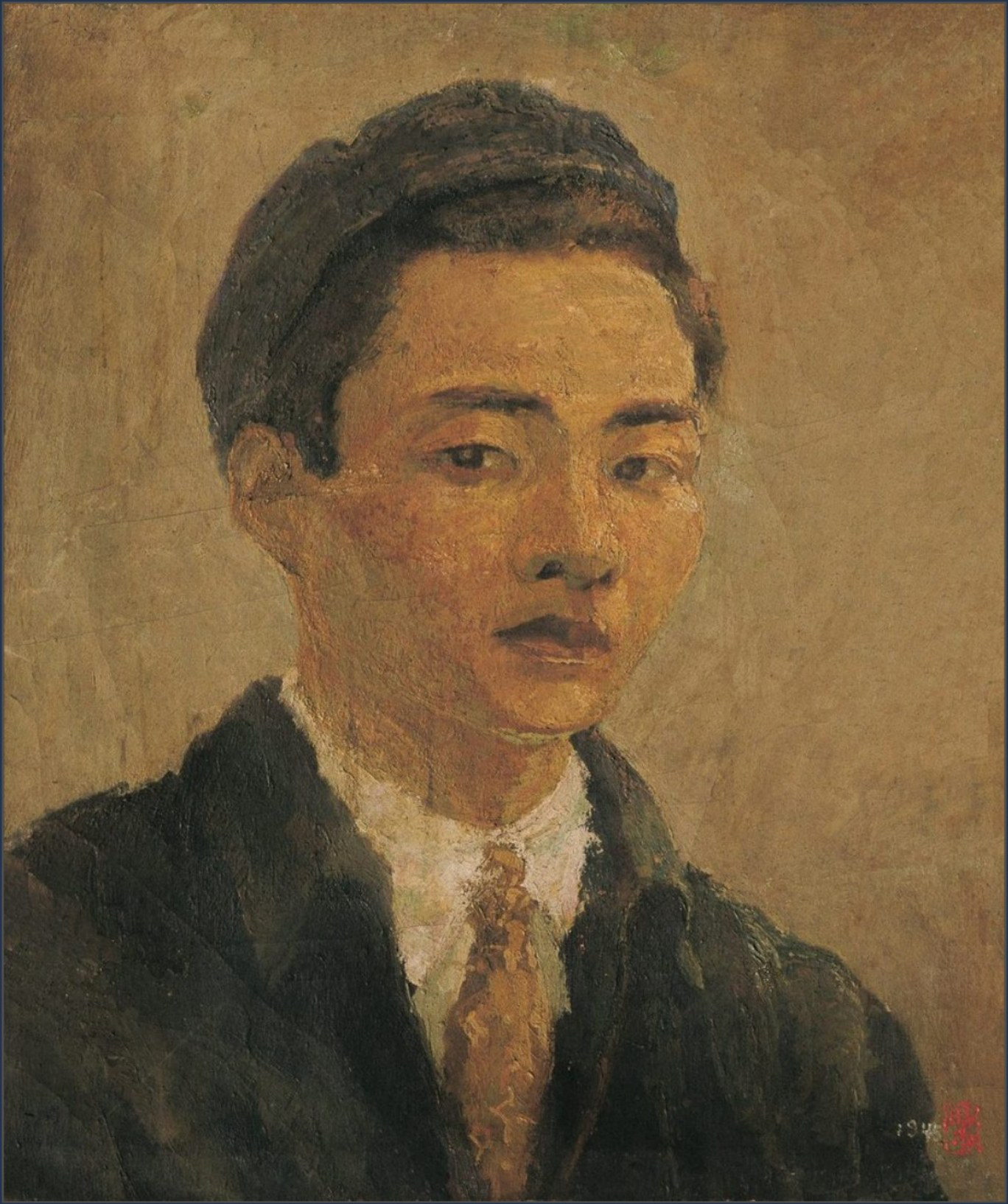
1A Face Before Twenty
In Self-Portrait (1944) there is one young face. Byun Shi-Ji painted it while attending the Osaka Art School, before he turned twenty.1 The young man wears a dark jacket, a white collar and a yellowish tie. The face is almost frontal, and the eyes look out of the picture. The background is an empty yellowish brown.
In the Jeju paintings people are usually small. They are drawn by the posture of the body more than by the features of the face. Many are recognized by a bent back. Yet this book places this face in the first chapter, which begins the historical lineage. And it is the painter’s own face.
Before analysing form and body, we first look at the lineage of one person’s movement, training and work that made them possible. What kind of face was the first face? And where did that face go afterwards?
2Face and Name
A self-portrait is usually painted looking in a mirror. The one who paints and the one painted are the same. So in a self-portrait the seeing eye and the seen eye overlap in one face.
The face is where a person is recognized. But for the young Byun Shi-Ji the face did not say everything about him. At the elementary school he attended in Osaka he was the only Korean child. In his oral history he looked back on that time: from the face alone you could not tell whether he was a Korean child or a Japanese child. Only when he gave his name did they know.2
At that time his name was Shigun (時君). In Japanese schools teachers called pupils by adding -kun (君) after their names. The name became “Shigun-kun,” a thing to tease him with, and he said he would not go to school. Because of this his father came back to Korea on purpose and changed the name in the family register. He chose ji (志), said to have the same number of strokes as kun (君), and the name became Shiji (時志).2
The face did not speak; the name did. Years later, as an art student, he painted that face himself. It is the first face, before the fūdo of Jeju entered his canvases.
3A Face Receiving Light
Figure painting at art school is training in looking. Light comes in from one side, lighting one side of the face and leaving shadow on the other. The difference between that light and shadow gives volume to forehead, nose and cheek. The eye is trained to transfer the shape of the subject exactly.
This was the kind of drawing that Byun Shi-Ji, a student in the Western painting department, learned. Self-Portrait (1944) is a picture of that time. Light comes from the upper left. The forehead and one cheek are bright; the other cheek and the neck fall into shadow. That light and dark model the face into roundness.
On the Jeju canvases, the place where a person is recognized moved from the face to the posture.
That does not mean the first face became useless. Only someone who has something can take it away. The hand that knew how to paint a face exactly later took the face away.
4An Ageing Face, a Person in the Landscape
In a tradition of repeating the self-portrait over a lifetime, as in Rembrandt’s series, the time of a life accumulates in the changes of the face.3 In Byun Shi-Ji a different route stands out.
Byun Shi-Ji made only a few self-portraits. One study names self-portraits of 1944, 1959 and 1995. According to it, the face of 1995 does not look forward but is lost in thought. Behind it is a horizon, with one boat afloat.4
In his pictures an old man in the landscape appears far more often than a self-portrait. According to Carole Neves, former director of policy analysis at the Smithsonian Institution, when asked whether that old man was a self-portrait he answered: “If people want to believe that the old man who appears in many of my paintings is me, they are free to do so.”5 It is an answer that says neither yes nor no.
In the second year of elementary school the painter injured a leg joint while wrestling.6 Neves wrote that he walked with a cane for decades.5 The old man in the paintings also leans on a cane. Borrowing the freedom he gave, this chapter reads it this way: unlike the self-portrait tradition in which life accumulates in the face, in Byun Shi-Ji’s pictures life more often accumulates in the posture of a small person in the landscape.
5The Beginning on the Easel
In the early 1970s he set up the “House of the Painter Byun Shi-Ji” in Donam-dong, Seoul. He is said to have kept a place to rest on one side, and to have hung Self-Portrait (1944) on an easel set before an armchair.4 At the time he was painting the Biwon, the rear garden of Changdeokgung Palace, in fine detail. It was a few years before he went down to Jeju.
No record shows the painter giving the reason himself. The study that reports this guesses that he may have wished to return to his first intentions.4 This much can be said: nearly thirty years later, he kept the first face in front of him.
In the face of Self-Portrait, the bright cheek and the shadowed cheek tell the direction of the light. The people in the Jeju paintings have no such shadow. This can be read not as erasing the beginning but as stepping on from it.
This chapter has confirmed that a colonial-period name and art-school figure training overlap in one face. The next chapter looks, through Portrait of Mr. K (1952), at what the hand that painted this face learned in Tokyo under his teacher Terauchi Manjirō.
Thirty years later, the first face was still on his easel.
Notes and sources
- ↑ Self-Portrait (1944). Date confirmed by the author. Hong Seong-hu’s essay (note 4) also gives 1944, a picture of the Osaka years. “The Language of Painting” gives 1945, painted “at nineteen.” The canvas is checked against the plate in the byunshiji.org 100 Works (FŪDO 038).
- ↑ Byun Shi-Ji Oral History Transcript (Korean Modern and Contemporary Art History Oral History Project; interviewer and researcher Lee In-bum), first session (3 December 2004, Gidang Art Museum), pp. 29–30. The painter remembers the name change as “around third or fourth grade.”
- ↑ Rembrandt’s self-portraits number some eighty: about forty oil paintings, thirty-one etchings and about seven drawings. See H. Perry Chapman, Rembrandt’s Self-Portraits: A Study in Seventeenth-Century Identity (Princeton University Press, 1990).
- ↑ Hong Seong-hu (researcher, Institute of Korean Art History, Myongji University), “Beyond Boundaries: The Life and Art of Byun Shi-Ji,” sections “The Donam-dong Years: The Biwon School” and “A Solitary Self-Portrait,” in the “Art and Fūdo” file. In his oral history the painter said he bought this house around 1970–71 meaning to make it a private museum, and used the third floor as a studio (fifth session, pp. 200–202).
- ↑ Carole Neves (director of policy analysis, Smithsonian Institution), “The Painter and the Sea: Byun Shi-Ji.” Quoted from the Korean translation.
- ↑ Byun Shi-Ji Oral History Transcript, first session, pp. 33–36.
Contents · Fūdo Is Not Landscape Key Terms and Analytical Categories → Bibliography →