Research/Fūdo Is Not Landscape/Argument I/Chapter 3
Academic edition · Fūdo Is Not Landscape · Chapter 3 · 5 / 34
Seoul’s Modernity and the Time of the Biwon
Endurance of Observation and the Art World of Postwar Seoul
Argument I · Modernity Is Reconstructed in Motion
1Counting Roof Tiles
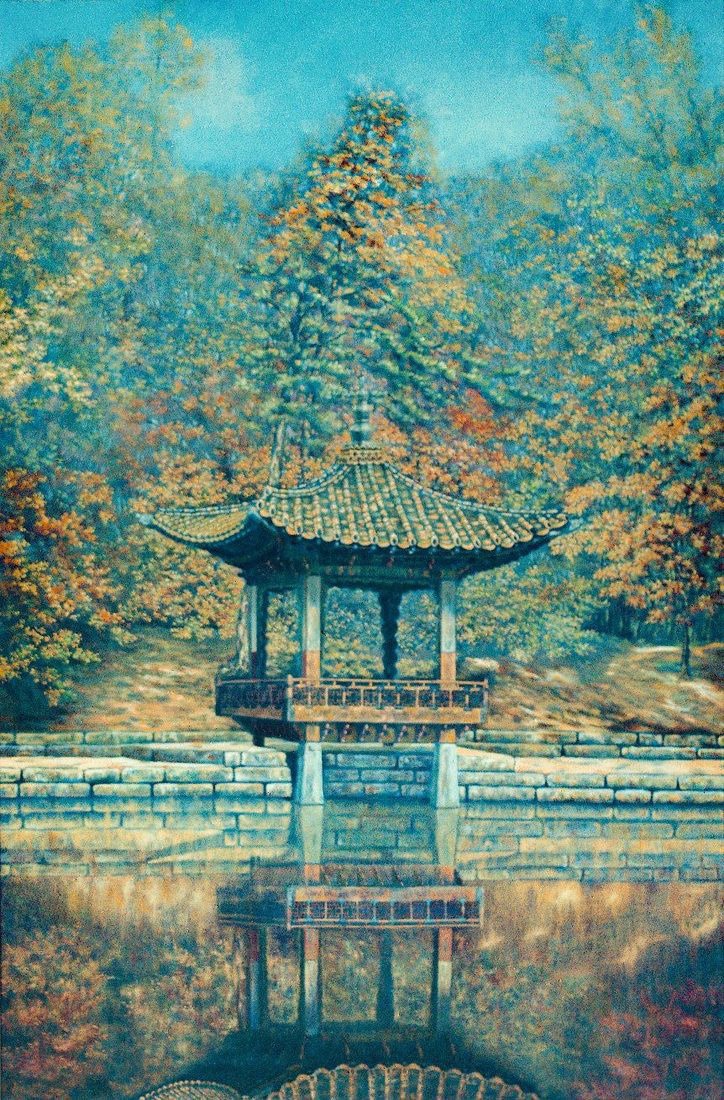
In Autumn at Aeryeonjeong (1971) there is a pavilion by a pond. It is Aeryeonjeong, within the Biwon, the rear garden of Changdeokgung Palace mentioned in chapter 1. The season is autumn.1 The roof tiles are painted one by one, and the balusters of the railing stand one at a time. The pavilion sits on a stone embankment built at the pond’s edge, and in the water the pavilion and embankment are reflected upside down. Behind, trees turned yellow and red crowd together, and above them a little blue sky shows.
To paint such pictures he went to the Biwon every day for years, painting about three hours a day. He laid on the brush counting the roof tiles one by one, and a single size-10 picture took a month.2
When the interviewer remarked that after returning to Korea he mainly painted landscapes, he answered: “That was because of the Biwon…”3 What did he look for in the palace garden? And how did he later look back on it?
2A Matrix Felt Through the Skin
In 1958, the year after he came to Seoul, a newspaper column reported his words: he wished to wander the provinces, “first looking at customs and habits, local things, fūdo,” and to find an art that wells up from one’s constitution.4
Later he explained this thought. The fūdo of a country, the will and philosophy of its people, and what that society has gone through gather into one and become the “matrix” of art. He said it was not an idea taken from books or teachers but something felt “through the skin.”5 His book Art and Fūdo says the same: the conditions of people, era and climate become the matrix of art. He likened it to the “body heat” of spiritual culture. He also called this matrix “the fūdo of art.”6
Having come home, he had to find that matrix. Yet the man who said he would wander the provinces stayed longest in a palace garden.
3Palace Tiles, a Burdened Back
In the first years after coming to Seoul, many things passed across his canvases: red-brick university buildings, near-abstract pictures whose subject is hard to make out, portraits painted on commission.7 There was also a porter with an A-frame. The Porter (1958) is said to survive now only in a black-and-white photograph.8
As he remembered it, the Biwon opened to the public in the 1960s. From then on the Biwon became his workplace. The painters Son Eung-seong and Cheon Chil-bong also came out to paint every day. People called them the “Biwon school.”9
The pictures built up slowly. After painting every single leaf, he layered on thin colour and worked again as if starting from the beginning. A single leaf carried five or six layers of paint.10
He looked back on that time fondly. The days painting in the Biwon felt, he said, “like another world from the reality of Korea.”9
4Eyes That Saw Two Worlds
The palace garden and the labourer on the road were two faces of the same city. He had both an eye that counted roof tiles and an eye that saw a burdened back.
The Biwon too had its fūdo: a quiet garden, the same spot every day, slowly passing time. Within that fūdo grew a way of counting even single leaves. Whether the matrix he sought was there, he himself would later look back on. But the eye was formed there.
The two eyes went with him to Jeju. In the fūdo of Jeju, those eyes gained another way.
5From the Palace into the Wind
In the early 1970s he fell ill and was in hospital for a time. As he recovered, an invitation came from Jeju National University, and in 1975 he went to Jeju.11
At first in Jeju he too painted Jeju in the Biwon manner. But living there, he felt that it was “Jeju only on the surface, not in content.” A Jeju subject did not make a Jeju painting. It had to come from what he called the matrix—the fūdo, history and will of the people of that place. Later he looked back on the manner learned in the Biwon as “aristocratic culture.” And he said that in Jeju he dug into “the most ordinary, common things.”12
He gave up all the elegant, ornate colour of the Biwon. In its place came the color of dried grass. But he took with him the eye that had counted roof tiles. In Jeju, too, he watched storms and came home to paint them. The way of looking and looking again until it was held in the mind had become second nature in the Biwon.13
The tiles and leaves of Autumn at Aeryeonjeong were painted one by one. This chapter has confirmed that what the Biwon left him was not ornate colour but an eye that looks long and holds things in the mind. The colonial name and face, the drawing of bodies learned in Tokyo, and the long-looking eye formed in Seoul overlapped in turn within one person’s movement. The modern painting he learned can be read not as something carried unchanged from a centre, but as something rewoven again and again in this movement. This is the provisional conclusion of Argument I. In 1975 that eye returned to the island where he was born. Argument II asks, in chapters 4 and 5, whether that homecoming was a return to origins or a relearning.
The eye that counted roof tiles learned the wind by heart in Jeju.
Notes and sources
- ↑ Autumn at Aeryeonjeong (1971). Title and date follow “The Language of Painting.” Hong Seong-hu’s essay states that Aeryeonjeong was shown at the 1971 solo exhibition at the Fuji Gallery, Osaka. The canvas is checked against the plate in the byunshiji.org 100 Works (FŪDO 036). Date confirmed as 1971 by the author (30 September 2026); the date 1965 given in the 100 Works is to be corrected on the site.
- ↑ Byun Shi-Ji Oral History Transcript (Korean Modern and Contemporary Art History Oral History Project; interviewer and researcher Lee In-bum), seventh session (1 April 2005), pp. 297–298 (counting tiles, about three hours a day, a month for one size-10 picture).
- ↑ Same transcript, second session, p. 99.
- ↑ The 1958 piece by “Aekkunun” (“One-Eye”) quoted in Hong Seong-hu, “Beyond Boundaries: The Life and Art of Byun Shi-Ji” (in the “Art and Fūdo” file). Hong gives it as the column “Moil Mosi” in the Kyunghyang Shinmun, 4 June 1958.
- ↑ Byun Shi-Ji Oral History Transcript, third session (24 December 2004), pp. 150–151.
- ↑ Byun Shi-Ji, Art and Fūdo (Youlhwadang, 1988), “Art and Fūdo,” in the section “Living in Jeju.”
- ↑ Byun Shi-Ji Oral History Transcript, fourth session (28 December 2004), pp. 154–155 (red-brick buildings, portraits); third session, pp. 140–141 (near-abstract pictures).
- ↑ Work description in “The Language of Painting.”
- ↑ Byun Shi-Ji Oral History Transcript, fourth session, pp. 185–187.
- ↑ Same transcript, seventh session, pp. 297–298.
- ↑ Byun Shi-Ji Oral History Transcript, fifth session (18 January 2005), p. 200. He said he fell ill while fitting out the painter’s house and was hospitalized, and the invitation from Jeju National University came as he was leaving hospital.
- ↑ Same transcript, seventh session, pp. 303–304. “The most ordinary, common things”: third session, p. 151.
- ↑ Same transcript, seventh session, pp. 298–299.
Contents · Fūdo Is Not Landscape Key Terms and Analytical Categories → Bibliography →