Research/Reading the Masters/Ⅵ Those Who Saw Visions
Ⅵ — Those Who Saw Visions · No. 34 / 50
Henri de Toulouse-Lautrec — At the Moulin Rouge
로트레크 — 〈물랭 루즈에서〉
1892–1895. Oil on canvas, 123 × 140.5 cm. Art Institute of Chicago.
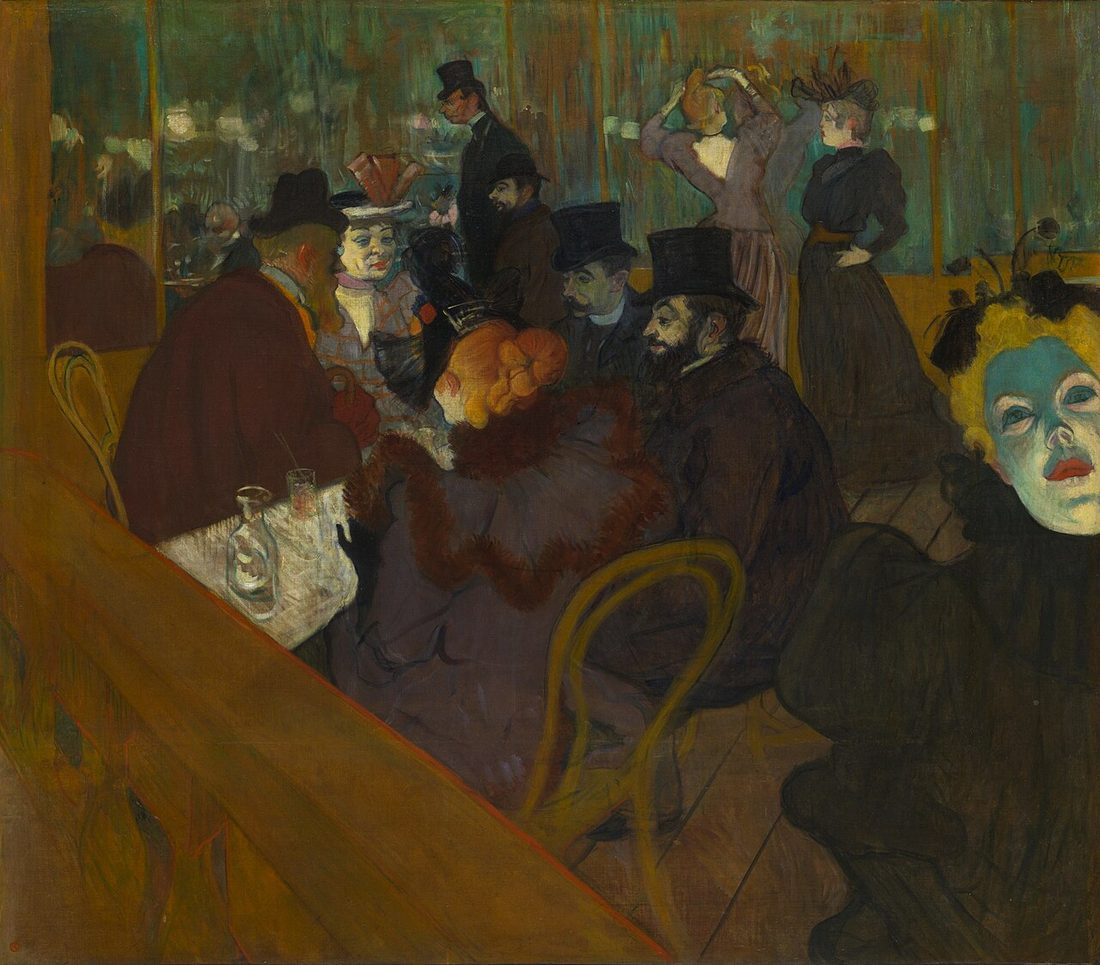

It is a nocturnal interior. People sit around a table, while a pale face enters abruptly from the right edge.
Toulouse-Lautrec painted the glitter of the Moulin Rouge but not pleasure alone. Under gaslight, faces are tired. Conversation continues, yet each figure remains within a private solitude.
Bold cropping and flat composition, learned partly from Japanese ukiyo-e, create the unstable sensation of modern nightlife. A figure is cut by the edge like a photograph, and artificial light turns faces into unnatural color.
Byun Shi-Ji’s nights contain no neon. They contain dry fields, black lines, crows, and thatched houses. Lautrec’s night is lonely because it is crowded; Byun’s because almost no one is there.
The solitude after revelry and the solitude of silence are different, yet both look toward the human place beyond the reach of light.
The music has ended, but no one has gone home.
The interpretation is the author’s. No unverified statement has been presented as the artist’s own words.