Research/Reading the Masters/Ⅵ Those Who Saw Visions
Ⅵ — Those Who Saw Visions · No. 33 / 50
Paul Gauguin — Tahitian Women on the Beach
고갱 — 〈타히티의 여인들〉
1891. Oil on canvas, 69 × 91.5 cm. Musée d’Orsay, Paris.
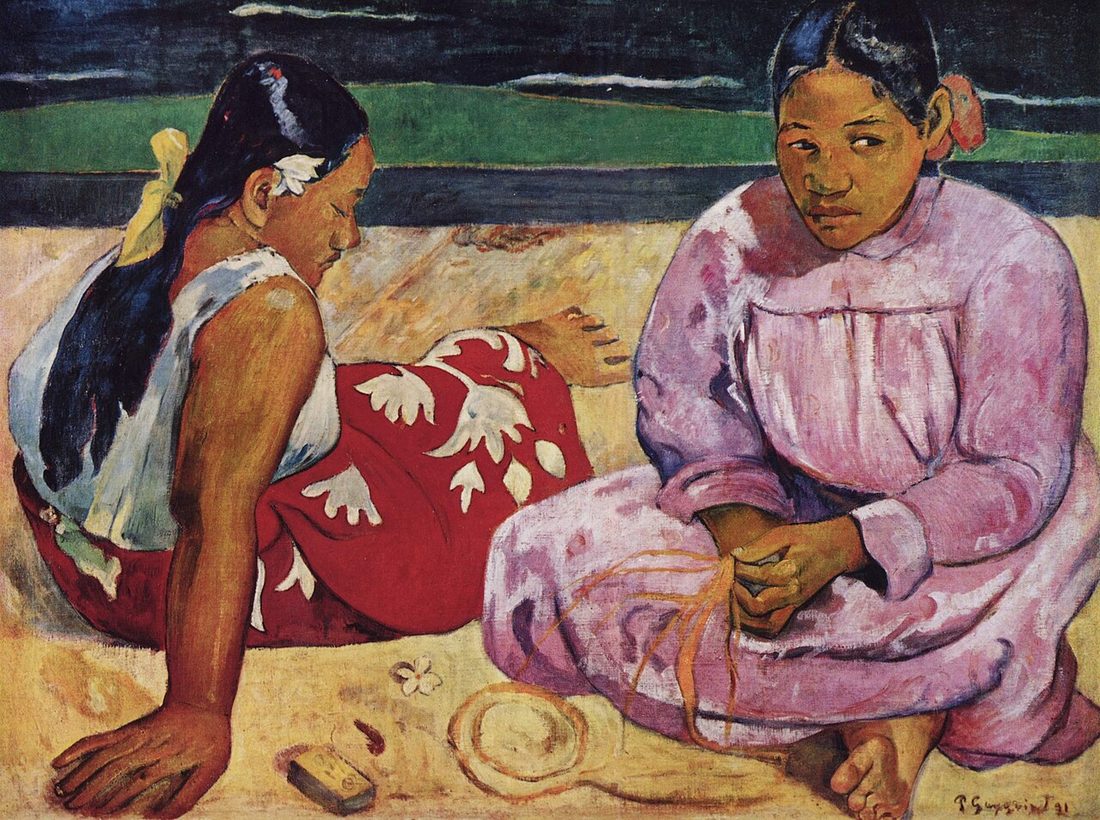

Two women sit on a beach. One looks aside; the other handles something in her hands. Color is flat, and contour is firm.
Gauguin left Europe in search of a more elemental life in Tahiti. Yet the Tahiti he painted was both a real island and a paradise imagined by a European. Behind the calm surface lie colonial reality and the problem of how one looks at the life of another.
He reduced naturalistic modeling and built the figures through broad color fields and strong outlines. The flatness he learned from Japanese prints and non-Western forms renewed his painting, while also leaving the question of whether other lives had become symbols of his own desire.
Byun Shi-Ji did not travel to another person’s island. He returned to his own birthplace. Yet Jeju was no paradise of return: the wind was harsh, the land dry, and homecoming became endurance rather than consolation.
Gauguin searched for climate and place by leaving; Byun endured them by returning. Neither path is simple. Art paints the land and, at the same time, exposes the gaze brought to that land.
The two women still do not speak.
The interpretation is the author’s. No unverified statement has been presented as the artist’s own words.