Research/Reading the Masters/Ⅲ Those Who Broke the Form
Ⅲ — Those Who Broke the Form · No. 17 / 50
Piet Mondrian — Composition with Red, Blue and Yellow
몬드리안 — 〈빨강, 파랑, 노랑의 구성〉
c. 1930. Oil on canvas. One of several related compositions.
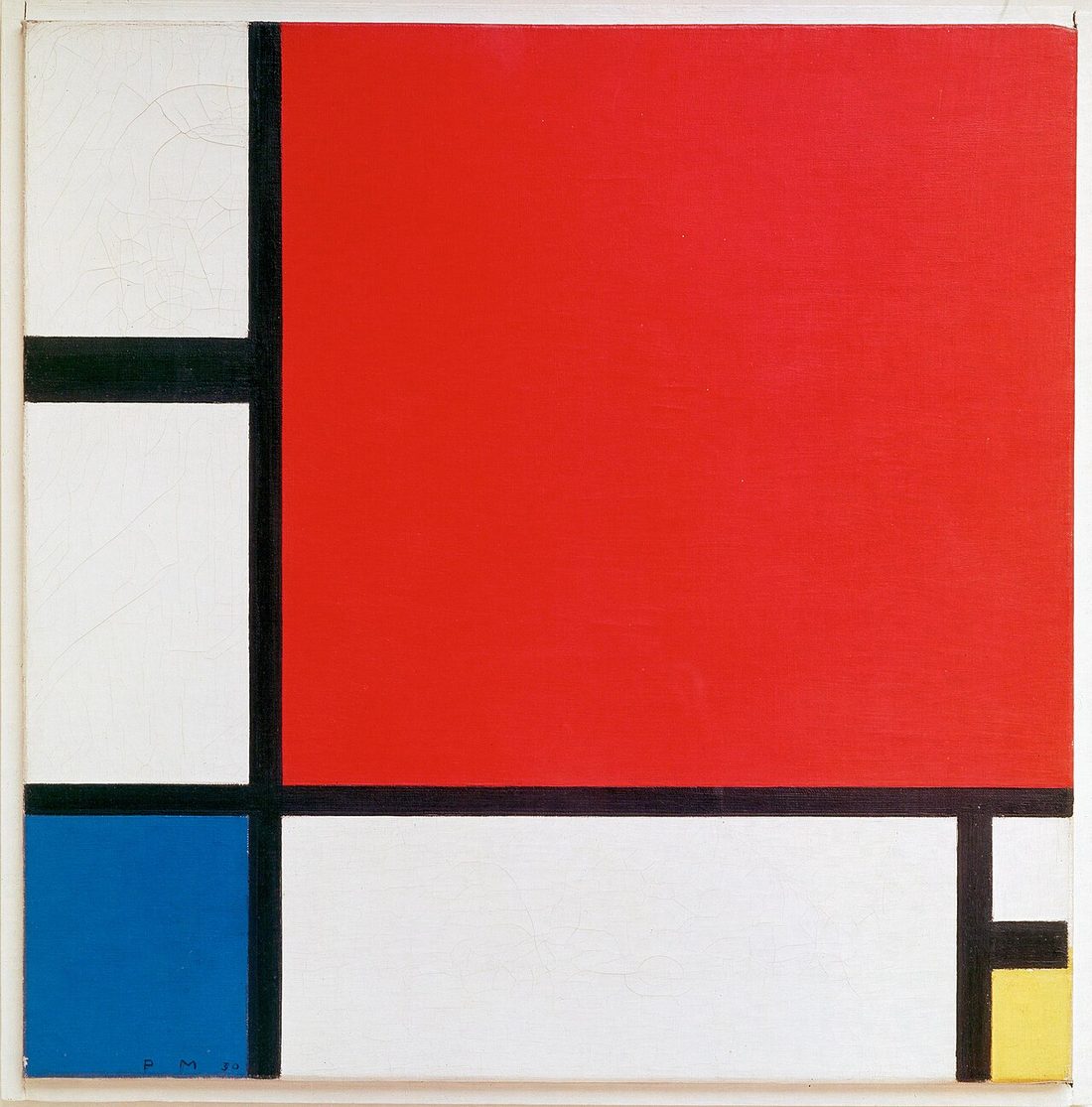

On a white ground stand black verticals and horizontals. A few planes of red, blue, and yellow appear. That is all.
Mondrian arrived here after years of painting trees and landscapes—gradually reducing branches, eliminating curves, and leaving only vertical and horizontal relations. Abstraction was not the abandonment of nature but the result of pursuing its order to an extreme.
Vertical and horizontal do not cancel each other. They create balance through tension. The planes are unequal, and the center is not perfectly centered. Order emerges not from symmetry but from a balance capable of sustaining imbalance.
Byun Shi-Ji’s paintings also contain horizons and upright human figures. Yet Mondrian’s lines dream of an absolute order without wind, while Byun’s lines bend because the wind is always present. One straightens the world; the other shows how to remain while leaning.
Straightness and bending are different ethics. Neither can replace the other.
A small blue plane holds a wide white field in place.
The interpretation is the author’s. No unverified statement has been presented as the artist’s own words.