Research/Reading the Masters/Ⅲ Those Who Broke the Form
Ⅲ — Those Who Broke the Form · No. 16 / 50
Wassily Kandinsky — Improvisation 31 (Sea Battle)
칸딘스키 — 〈즉흥 제31번(해전)〉
1913. Oil on canvas, 140 × 120 cm. National Gallery of Art, Washington, D.C.
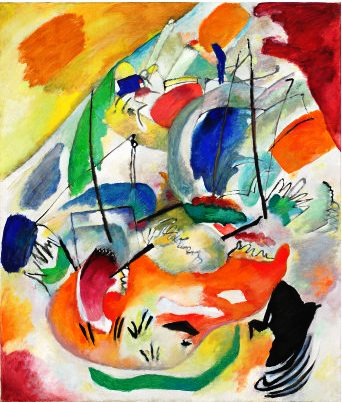

There seem to be ships and waves, but form quickly disperses into color and line. Red and black strokes collide, while blue planes cross the surface.
For Kandinsky, painting was no longer the transcription of a visible object. Color and line could sound directly. Like music, painting could produce emotion without explaining a concrete thing.
The title Improvisation does not mean the absence of structure. It names an order of inner necessity, rapidly organized by a disciplined sensibility. Traces of a sea battle remain, but the rhythm of collision and tension takes precedence over narrative depiction.
Byun Shi-Ji’s line also exceeds contour. Kandinsky’s line becomes a vector of force within the picture; Byun’s becomes the trace left by an invisible wind. One belongs to abstract movement, the other to the pressure of climate and place.
Both ask not what a line resembles, but how it moves and how it endures.
The battle disappears. Only the collision of lines remains.
The interpretation is the author’s. No unverified statement has been presented as the artist’s own words.