Research/Reading the Masters/Ⅱ Those Who Went Into the Dark
Ⅱ — Those Who Went Into the Dark · No. 11 / 50
Ernst Ludwig Kirchner — Berlin Street Scene
키르히너 — 〈베를린 거리〉
1913. Oil on canvas. From Kirchner’s Berlin street-scene series.
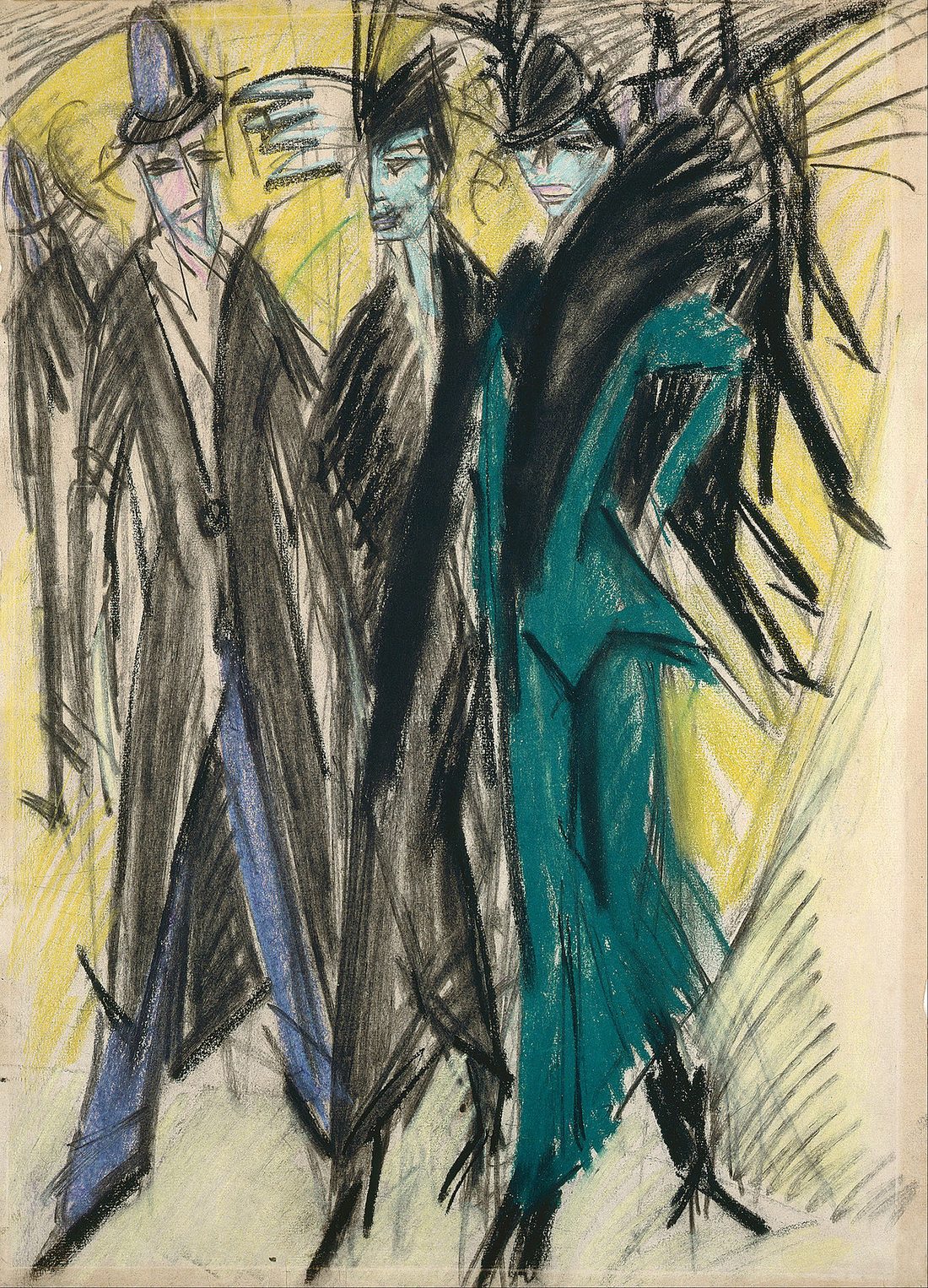

It is a crowded Berlin street. Faces harden into green, shadows distort into violet, and buildings and bodies seem to lean at unstable angles.
Kirchner’s figures are walking, yet they seem less to walk than to be carried along. Similar clothes, similar postures, similar speed: the modern crowd multiplies people while erasing their individual faces.
Color no longer reproduces reality. Faces are not green and streets are not violet. Kirchner painted the dissonance heard within rather than the colors seen outside. Where Impressionism sought the harmony of light, Expressionism seized the instant in which harmony breaks.
Byun Shi-Ji’s paintings contain almost no crowds. Kirchner’s people lose their names because there are too many of them; Byun’s solitary figure remains because there is almost no one else. One space is where urban speed consumes the person; the other is where island wind reveals him.
The solitude of a crowd and the solitude of an empty field are not the same. Yet both contain the tension of a person trying not to lose his place.
They are still walking. No one looks at anyone else.
The interpretation is the author’s. No unverified statement has been presented as the artist’s own words.