Research/Fūdo Is Not Landscape/Introduction
Academic edition · Fūdo Is Not Landscape · Introduction · 1 / 34
Fūdo Is Not Landscape
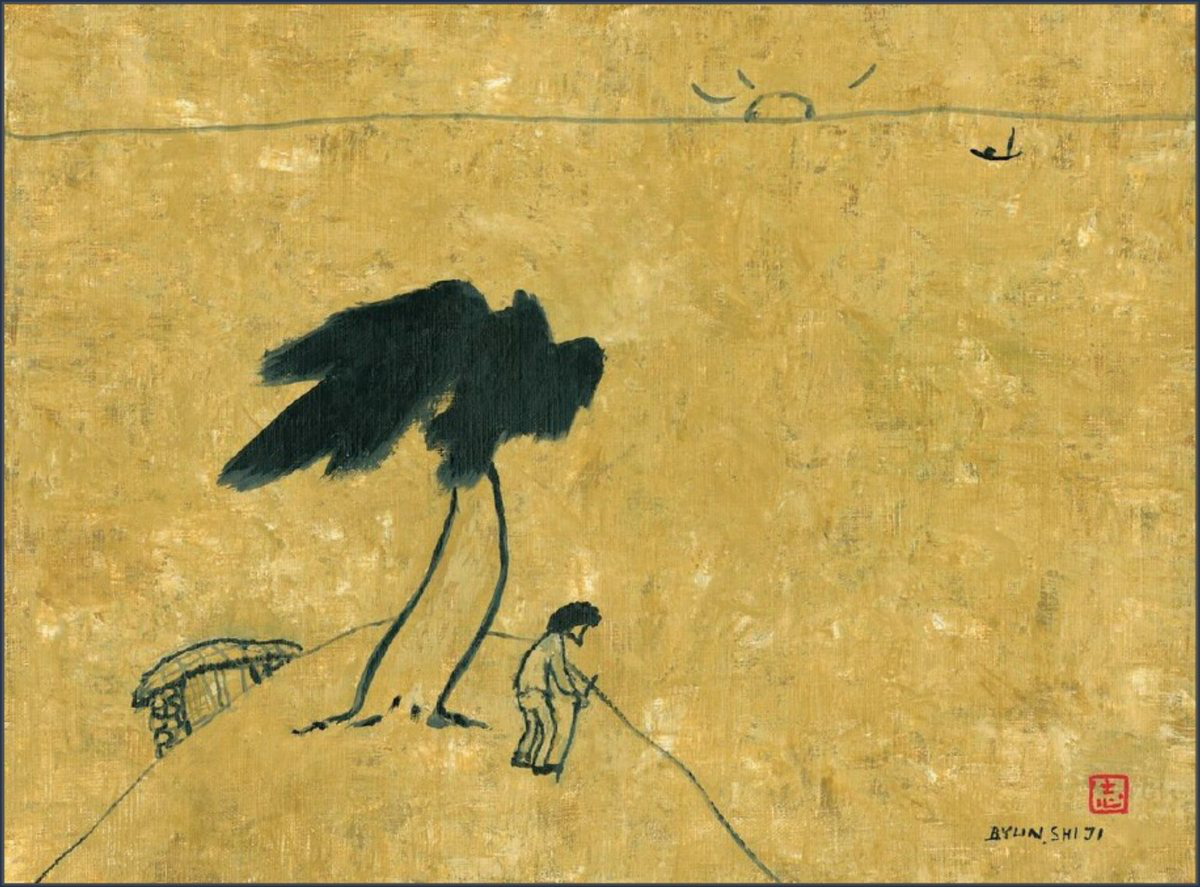
An old man stands on a hill the color of dried grass. The pine beside him and the old man’s back both lean to one side.1
Leaning a little, standing long.
This book does not begin by reading this scene as a description of Jeju landscape. The question lies rather on the other side. Why were wind and sunlight, sea and stone, labour and memory transformed into the line, colour, empty space and posture of painting?
In Byun Shi-Ji’s painting, Jeju is a condition that changes form before it is a list of iconography. This book calls that condition “fūdo.”
The core proposition compresses into three sentences. Fūdo is not landscape. Fūdo enters the body. Fūdo that has entered the body turns into form. These three sentences are this book’s memory device. In scholarly terms, fūdo is limited to a condition that is embodied in the relation between body and environment, not an external cause, and that is translated into pictorial form through work.
The object of this study is therefore not “pictures of Jeju” but the question of how time lived long in Jeju reorganized the grammar of painting.
1The Problem: Limits of the Label “Jeju Landscape Painter”
Calling Byun Shi-Ji “a painter of Jeju” or “a regional painter” holds a certain truth, but it also risks fixing his painting in the category of subject matter. That sea, thatched houses, horses and crows point to Jeju cannot by itself explain the sharp simplification, flattening, convergence of colour and reduction of figures in the late paintings.
This book moves regionalism from a question of content to a question of how form is generated. Rather than the fact that local subjects entered the canvas, it traces how time spent in one place changed habits of sight and body, and how that change settled into the organizing principle of the picture.
From this viewpoint the 1975 settlement in Jeju is not a rupture but an occasion for transformation. The structure of figure painting acquired in Japan, the endurance of observation trained in Seoul’s Biwon, and the wind and sunlight embodied in Jeju are rearranged without erasing one another.
Byun Shi-Ji’s Jeju painting therefore cannot be reduced to the result of homecoming or a return to tradition. It is pictorial skill accumulated through movement and reorganized within a particular fūdo.
2Landscape, Fūdo, Milieu
Watsuji Tetsurō’s Fūdo (1935) presented fūdo not as the physical sum of an external environment but as a relational condition in which human existence already finds itself.2 Augustin Berque held that translating the concept as milieu rather than simply climate better captures its mutual constitution.3
Merleau-Ponty’s phenomenology of perception likewise does not place the gaze at a neutral observation point outside the world. The seeing body is not separate from the world.4 This book uses such thought not as evidence of influence but as a comparative coordinate for analysing the embodied visuality found on Byun Shi-Ji’s canvases.
Here, then, landscape means a visual scene that a subject surveys from a distance, while fūdo means the condition of a “lived place” in which body, climate, daily life, time and social memory are entangled.
3Beyond Environmental Determinism
Stressing fūdo does not mean saying that Jeju’s natural environment one-sidedly “determined” pictorial form. Such an explanation shrinks the work to a passive result of climate.
In fact the bent body already existed in figure paintings before Jeju, and the concern with simplification formed in the Tokyo years. What Jeju did was not create a new form from nothing, but set already accumulated formal sense and skill working again in a different network of relations.
For this reason the sentence “fūdo becomes form” in this book is not a causal law but a description of mediation. Fūdo is translated into pictorial form as it passes through the painter’s body, memory, training, labour and medium.
Tim Ingold’s “dwelling perspective” and “taskscape” reinforce this point. Place is not a finished background; it forms in the temporal entanglement of activities in which people work, move, wait and care.5 This is why the book reads the haenyeo’s body, ploughing, and the relation of horse and person as a fūdo of labour.
Fūdo is not a summation that simply joins nature and culture, object and subject. It is a relational category that asks how these distinctions constitute one another in actual life.
The book therefore presents formal evidence from the works and biographical material first, and places philosophical concepts after them, in a limited way. This keeps theory from speaking in place of the works.
The wind, too, is not read first as a symbol. First we see the tilted line, the lowered house, the direction of the mane, the central axis of the body. Interpretation comes after.
This order is the methodological principle of the whole book: facts on the canvas → the artist’s words as confirmed by sources → formal analysis → comparative theory → limits of interpretation.
4Modernity in Motion: Western-Style Painting via Japan and Colonial Mediation
Byun Shi-Ji’s “modern painting” did not move straight from Europe to Jeju. Western painting reached Korean painters through Japanese art education and the exhibition system, and after Liberation it was rearranged again within Korean institutions and the Korean art world. The Space Between: The Modern in Korean Art, organized by LACMA and the National Museum of Modern and Contemporary Art, Korea, presents Korean modern art of 1897–1965 as exactly such a history of multiple mediation and reinterpretation.6
In particular, Kim Ji-young’s research on the Osaka Art School points out that its Korean students cannot be seen simply as “students studying in Japan.” Many Korean students in Osaka had come to Japan with their families in the course of imperial industrialization and migration, and after Liberation many returned not to Seoul but to Jeju and the southern regions, where they took part in art education and regional art.7 Byun Shi-Ji’s Osaka experience must also be examined within this historical field.
Instead of a one-way history of influence—European modernism → Japan → Korea—this book traces the routes by which form changed as it passed through imperial movement, education, language and the exhibition system. That is why the first part of the book is set in “modernity in motion.”
5Fūdo Modernism and Neighbouring Concepts: What Differs
It is not enough to define Byun Shi-Ji’s late painting as anti-modernism or a return to tradition. He learned the anatomy, perspective, modelling and colour theory of Western painting in Japan, and later in Jeju gradually loosened those rules or turned them to other functions. Flatness is strengthened, but the sense of distance does not vanish; figures shrink, but representation is not abandoned.
The “fūdo modernism” proposed here is neither a historically organized movement nor the painter’s own name for himself. Unlike a regionalism that paints the iconography of a particular place, it is an analytical concept for a process in which the language of modern painting, acquired elsewhere, is formally reconstructed as it passes through long experience of dwelling.
This category does not seek to rename existing regionalism or theories of place. Critical regionalism has addressed the tension between universal technological civilization and the specificity of place;8 multiple modernities, the plurality of modernity;9 and decentred modernisms, art history’s model of centre and derivative periphery.10 Fūdo modernism narrows these problems to a micro-level question: how one painter’s long dwelling accumulated in perception, body and working process, and how that accumulation was translated into the pictorial layers of line, colour, space, scale and repetition.
Where fūdo modernism differs from these is in the scale of analysis. Rather than explaining the identity of a region or the whole of plural modernities, it traces how one painter’s long dwelling accumulated in perception, bodily habit and working process, and how that accumulation was translated into the pictorial layers of line, colour, space, scale and repetition.
Fūdo modernism is therefore not the name of a movement but a micro-model of a working process. In English it is not fixed as a proper noun; the explanatory phrase “a modernism of milieu” is used. The Japanese romanization fūdo is used only where Watsuji’s concept is discussed directly. (In this web edition, following the byunshiji.org archive, Fūdo is used throughout.)
6Method and the Hierarchy of Sources
This study distinguishes four kinds of source. First, the visible facts of the works themselves. Second, the artist’s published writings and oral history. Third, exhibition records, newspapers, chronologies and criticism. Fourth, family testimony and the author’s direct confirmation. The four layers do not carry equal evidential weight, and where they conflict the difference is stated in the text or notes.
Dates, titles, materials, dimensions and collections in particular must be settled before interpretation. Square brackets in this manuscript mark items not yet checked against original sources. In the published edition, unconfirmed facts are not used as premises of the argument.
The same principle applies to reading the canvas. What is visible in the work, what the artist is confirmed to have said, and what the author interprets are kept apart at the level of the sentence.
7Principles of Comparison and the Hierarchy of Theory
The outside theories this book calls on are not lineages proven to have influenced Byun Shi-Ji directly. They are used not to construct a history of influence but as comparative coordinates for articulating more precisely the problems raised by the works and sources.
Comparisons are also ranked. Theories directly concerned with fūdo, perception, labour, flatness and decentring serve as the core analytical frame; juxtapositions with other artists and thinkers are used only in a limited way, to test differences of specific forms. This keeps comparison from standing in front of the works.
8“The Aesthetics of Not Fighting” and “the Posture of Resistance”: Analysis in Two Layers
This book does not treat “the aesthetics of not fighting” and “the posture of resistance” as mutually exclusive. The two phrases point to relations with different forces.
“The aesthetics of not fighting” refers to a pictorial form that does not make the forces of nature an object of conquest, but sustains relation through lowering, tilting and pausing. In Art and Fūdo the painter wrote of standing on the pier, looking at the horizon, with the sense that humans “will never be able to overcome great nature.”11 On his canvases trees lean, houses grow low, people bend their backs. Not fighting does not mean not enduring. It means not trying to win.
“The posture of resistance” refers to the layer of relation with historical and political forces. In 2005 testimony the painter described the lives of Jeju people as “the tenacity of trying to survive, fighting and resisting the wind,” and recalled that his own heart, resisting dictatorship, fitted that subject “psychologically.”12 Because this statement is a self-interpretation later than the works, it is not used to prove the original intention of any single work (chapter 16, case A). It does show, however, that the painter understood the bending on his canvases not as defeat but as endurance.
The bent body therefore cannot be defined as the absence of resistance. At the same time, a form that lowers the body before nature cannot be reduced directly to an icon of political resistance. The two layers are not the same, but on Byun Shi-Ji’s canvases both sometimes appear less in scenes of direct clash than in the transformation of a body that has received force—bending, tilting, lowness, stillness. This book analyses the place where the two layers meet within a work as “the form of the bent body,” and preserves that point of contact not as identity but as tension.
So “the aesthetics of not fighting” is not a phrase that erases resistance, and “the posture of resistance” is not a phrase that turns every bent body into a political symbol. The relation of the two concepts is examined again with the works in chapter 16, case B.
9Map of the Argument and Structure of the Book
This book groups twenty chapters under nine arguments. Each argument is treated not as a declaration but as a falsifiable hypothesis.
Argument I. Modernity is not copied from centre to periphery but reconstructed within moving institutions, skills and bodies (chapters 1–3).
Argument II. Homecoming is not a return to the starting point but a process of perceiving and learning a familiar place again (chapters 4–5).
Argument III. Byun Shi-Ji’s expression is not the result of abandoning representation but of passing through repetition and the training of representation, and subtracting what was unnecessary (chapters 6–7).
Argument IV. Fūdo is not a background but a system of sight and distance. Horizon, distant boat and flatness organize the structure of perception of life on an island (chapters 8–9).
Argument V. Fūdo takes form in colour, line, empty space and light. The color of dried grass and the black line are not markers of place but a pictorial grammar that recurs in the group of Jeju works (chapters 10–11).
The results of these five arguments are gathered in the “theoretical interim conclusion,” which redefines the analytical term proposed in the introduction, fūdo modernism, distinguishing it from the discourse of local colour.
Argument VI. Fūdo organizes the posture of body, tree and house. Tilt, lowness and direction are the forms of different beings and structures that have entered into relation with outside forces (chapters 12–13).
Argument VII. Labour and animals reveal the relations and choices of the body. Not every image of an animal belongs to this network, however, and exceptional works limit the scope (chapters 14–15).
Argument VIII. Before the forces of nature, Byun Shi-Ji’s canvases do not try to win (“the aesthetics of not fighting”). Yet they do not disappear. The artist’s memory of the forces of his time (“the posture of resistance”) is not the same as this form, but meets it in the bent body. Resistance, loss and waiting can appear not as heroic uprightness or a narrative of victory but as a form of persistence that remains while lowering and leaning. This is not a single emotional model covering all the works (chapters 16–17).
Argument IX. Byun Shi-Ji’s modernity is located through parallel comparison within Korean contemporary art and through the asymmetric translation of the word fūdo (chapters 18–20).
At the head of each argument a table sets out ① claim, ② evidence in the works, ③ primary sources, ④ counter-examples, ⑤ limits of the sources, ⑥ difference from existing art history, ⑦ provisional conclusion. A counter-example is not a caveat or a lack of sources but a work that actually does not fit the proposition. Time gaps in sources and bibliographic uncertainty are recorded separately under “limits of the sources.” A whole period is not generalized from the impression of one work or the artist’s later recollection alone.
Several chapters bind two cases that illuminate each other. Chapter 4, for example, treats the staying of The Empty House together with the looking-again of Jeju (1976); chapter 16 treats the enduring posture of Typhoon together with the bent body of The Old Pine and the Old Man. Cases A and B answer the same question with different works, and the chapter’s opening and close bind that question.
The final conclusion does not consume the artist’s words—calling his life exile and the work of painting a blessing—as a romantic aesthetics of suffering. By examining how the conditions of life were turned into form through work, it brings to light the ethics of “work” that lies between exile and blessing.13
The aim of this book is neither to confine Byun Shi-Ji within the regionality of Jeju nor to dissolve him into the abstract universality of world art history. It asks how a form deeply rooted in a place can be read again by viewers in other places.
Fūdo is not landscape. It is not a background outside the picture, but the condition of relation through which the picture came to be painted as it was.
10Primary Sources, Corpus and Research Ethics
The core primary sources are Byun Shi-Ji’s Art and Fūdo (Youlhwadang, 1988); the Byun Shi-Ji Oral History Transcript from the 2004–2005 Korean Modern and Contemporary Art History Oral History Project; the artist’s notes; exhibition and newspaper material; and currently verifiable reproductions of the works.14
The family’s direct memories of the works are important testimony, but they are marked separately from publications, catalogues and examination of originals. That the author is the painter’s son is an advantage in access to sources and also creates the possibility of interpretive bias. Family memory is therefore treated not as the final court that fixes a work’s meaning but as first-hand testimony to be checked against other sources.
This book therefore does not use family memory as “the final court of evidence.” Instead, it lets readers judge by showing the source and level of confirmation of each item.
Comparative theory is not a yardstick for ranking the value of works. It is a tool for comparing through what mediations the problems of modern painting were reconstructed in different places.
Under these principles “fūdo modernism” is presented not as a finished theory but as a testable hypothesis. How much explanatory power the concept has across the whole body of work is judged by the formal analysis in each chapter.
Now we go to the first face. Before speaking of the form of fūdo, it is time to see where and how the body that learned that form was made.
Notes and sources
- ↑ The picture in the opening scene is The Old Pine and the Old Man (1987), checked against the plate in the byunshiji.org 100 Works (FŪDO 079). A description of the canvas is in the notes to chapter 16.
- ↑ 和辻哲郎, 『風土 — 人間学的考察』 (Iwanami Shoten, 1935); Watsuji Tetsurō, Climate and Culture: A Philosophical Study, trans. Geoffrey Bownas (New York: Greenwood Press, 1988).
- ↑ Augustin Berque, "Milieu et logique du lieu chez Watsuji," Revue Philosophique de Louvain 92, no. 4 (1994): 495–507.
- ↑ Maurice Merleau-Ponty, “Le doute de Cézanne” (1945), Sens et non-sens; English trans. “Cézanne’s Doubt,” in Sense and Non-Sense, trans. Hubert L. Dreyfus and Patricia Allen Dreyfus (Evanston, IL: Northwestern University Press, 1964).
- ↑ Tim Ingold, "The Temporality of the Landscape," World Archaeology 25, no. 2 (1993): 152–174.
- ↑ Virginia Moon, ed., The Space Between: The Modern in Korean Art (Los Angeles: Los Angeles County Museum of Art / DelMonico Books, 2022). The exhibition was organized jointly by the Los Angeles County Museum of Art and the National Museum of Modern and Contemporary Art, Korea.
- ↑ Kim Ji-young, “On the Conditions of Korean Students at the Osaka Art School before Liberation and Their Whereabouts after Returning Home” (in Korean), Journal of Korean Modern and Contemporary Art History 32 (2016): 202–230.
- ↑ Kenneth Frampton, "Towards a Critical Regionalism: Six Points for an Architecture of Resistance," in The Anti-Aesthetic: Essays on Postmodern Culture, ed. Hal Foster (Port Townsend, WA: Bay Press, 1983).
- ↑ S. N. Eisenstadt, "Multiple Modernities," Daedalus 129, no. 1 (2000): 1–29.
- ↑ Partha Mitter, "Decentering Modernism: Art History and Avant-Garde Art from the Periphery," The Art Bulletin 90, no. 4 (2008): 531–548.
- ↑ Byun Shi-Ji, Art and Fūdo (Youlhwadang, 1988), “The Sun and Sea of Jeju,” in the section “Living in Jeju.” Discussed again in chapter 16.
- ↑ Byun Shi-Ji Oral History Transcript (Korean Modern and Contemporary Art History Oral History Project; interviewer and researcher Lee In-bum), fifth session (18 January 2005, Gidang Art Museum), p. 221. The words quoted are discussed again in chapter 16.
- ↑ In his lifetime the painter called his life “exile” and the work of painting “a blessing.” The author (his son) heard these words directly (author’s confirmation, 29 September 2026). The sentence “Life is exile, art is blessing” does not appear verbatim in the oral history transcript or in Art and Fūdo.
- ↑ Byun Shi-Ji Oral History Transcript (December 2004 – April 2005, seven sessions); Byun Shi-Ji, Art and Fūdo (Youlhwadang, 1988); Carole Neves, “The Painter and the Sea: Byun Shi-Ji”; Hong Seong-hu, “Beyond Boundaries: The Life and Art of Byun Shi-Ji”; “The Language of Painting.”
Contents · Fūdo Is Not Landscape Key Terms and Analytical Categories → Bibliography →