Research/Reading the Masters/Ⅴ Those Who Painted People
Ⅴ — Those Who Painted People · No. 27 / 50
Hieronymus Bosch — The Garden of Earthly Delights
히에로니무스 보스 — 〈쾌락의 정원〉
c. 1490–1510. Oil on oak panels, triptych, 220 × 389 cm. Museo del Prado, Madrid.
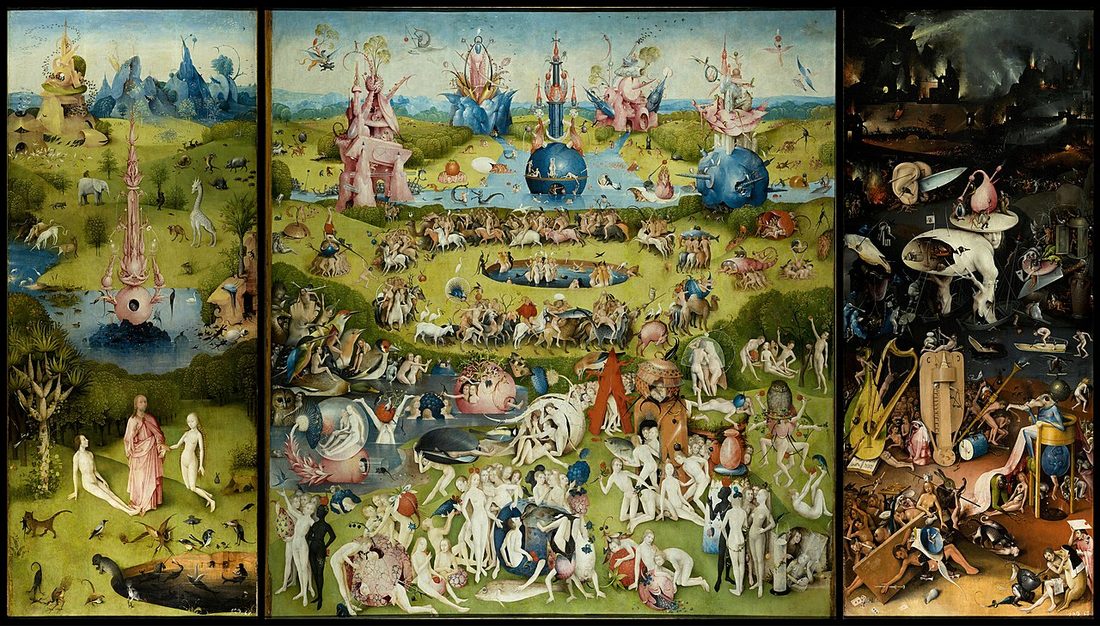

Three worlds unfold: creation at the left, endless pleasure in the center, and a nocturnal hell at the right.
Bosch’s surface is crowded beyond measure. Humans and animals, fruit and machines, instruments and monsters intertwine. The closer we look, the more stories appear, while meaning becomes less certain.
It is difficult to decide whether the work is primarily a moral warning or a carnival of human desire. What is clear is that as desire expands, the human body shrinks and becomes part of the objects surrounding it.
Byun Shi-Ji moves in the opposite direction. He erases almost everything and leaves one person, one horse, or one boat. Bosch loses the human through excess; Byun preserves the human within scarcity.
Both fullness and emptiness ask where the human being belongs. Where are we in a world containing too much? What remains of us in a world containing almost nothing?
The garden has not yet ended.
The interpretation is the author’s. No unverified statement has been presented as the artist’s own words.