Research/Reading the Masters/Ⅴ Those Who Painted People
Ⅴ — Those Who Painted People · No. 25 / 50
Giuseppe Arcimboldo — The Four Seasons
아르침볼도 — 〈사계〉
Multiple cycles from 1563 onward. Oil on panel or canvas. Major versions are held in Vienna, Paris, and other collections.
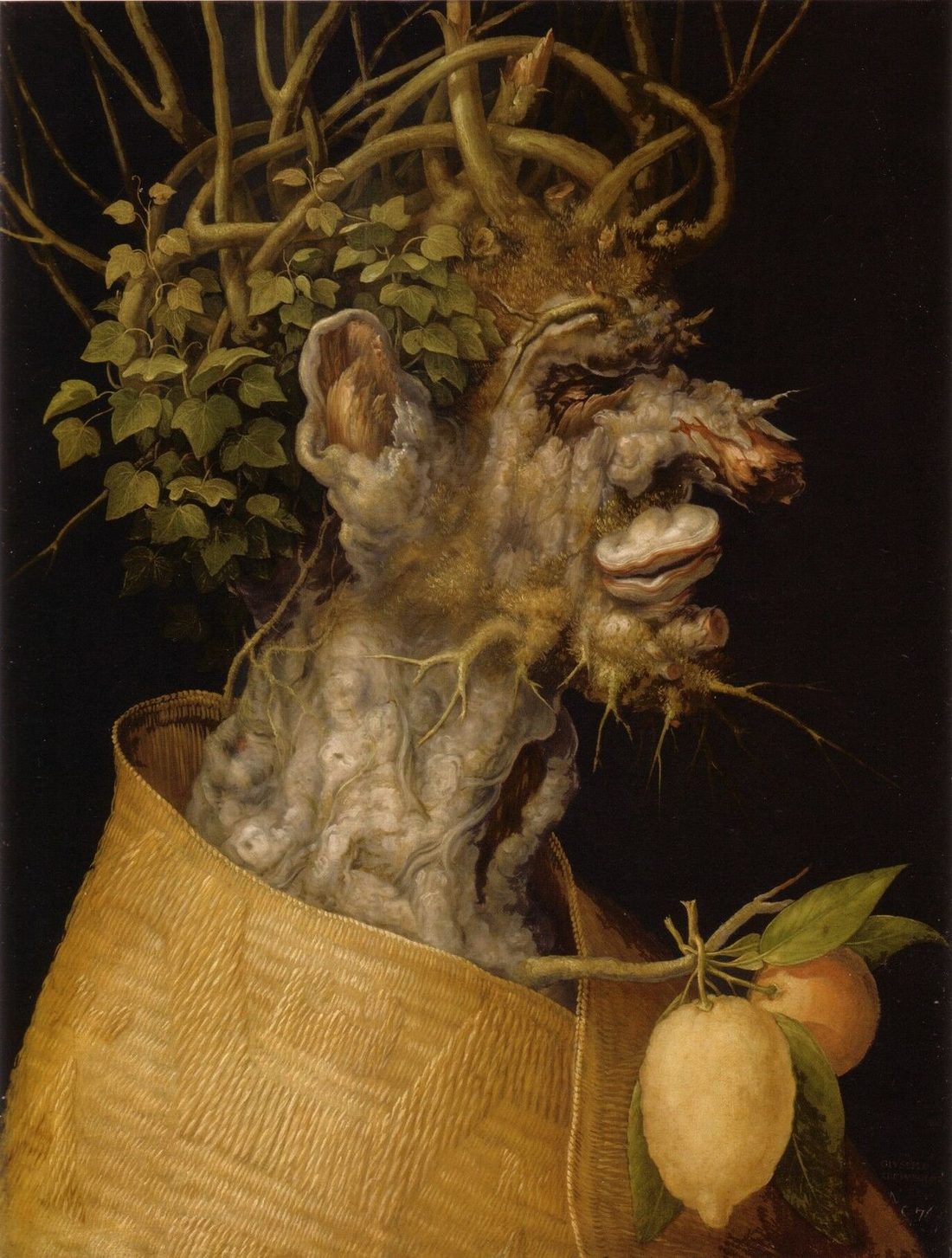

Flowers, fruit, grain, and bark assemble into a human face. Up close they remain natural objects; from a distance they become a portrait.
Arcimboldo’s images begin as wit but lead to a question about part and whole. Spring forms a youthful face from flowers; Winter builds an aged face from dry branches. The human body is reassembled from the products of the seasons.
The natural history and collecting culture of the Renaissance court are embedded in these strange portraits. Their humor depends upon precise observation.
Byun Shi-Ji did not construct people from natural objects. Instead, he slowly dissolved the boundary between person and environment. The old man’s body resembles the direction of wind; the leaning tree resembles a human posture.
Arcimboldo gathered parts to create a face. Byun allowed an entire climate to become visible within a single being. One is an aesthetics of combination; the other an aesthetics of permeation.
The fruit still forms a face.
The interpretation is the author’s. No unverified statement has been presented as the artist’s own words.