Research/Reading the Masters/Ⅳ Those Who Stood Before Nature
Ⅳ — Those Who Stood Before Nature · No. 21 / 50
Sandro Botticelli — The Birth of Venus
보티첼리 — 〈비너스의 탄생〉
c. 1484–1486. Tempera on canvas, 172.5 × 278.9 cm. Uffizi Galleries, Florence.
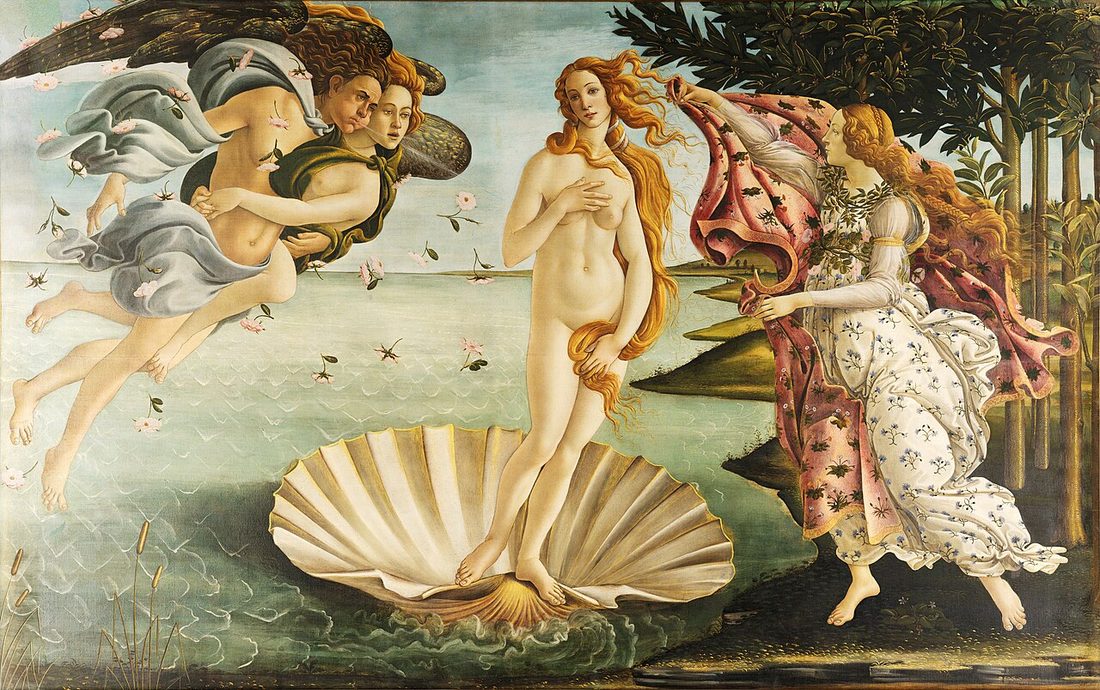

A shell floats upon the sea. A woman stands upon it. Wind pushes her hair and the garments around her, while a red mantle waits on the shore.
Botticelli’s Venus is not anatomically perfect. Her neck is elongated, her shoulders slope, and her balance is not entirely natural. Yet this very deviation transforms the body into an ideal. He chose the rhythm of line over anatomical exactitude.
Line is both contour and direction of wind. Hair, waves, trees, and cloth move within the same current. Beauty appears not as a fixed form but as the tremor of arrival.
Byun Shi-Ji’s wind is harsher and drier. Botticelli’s wind carries birth toward the shore; Byun’s tests beings already living. One concerns arrival into life, the other the endurance of life.
Yet both painters make an invisible force visible through the way bodies and lines are moved.
Venus has not yet reached the shore.
The interpretation is the author’s. No unverified statement has been presented as the artist’s own words.